When Anxiety Knocks, Are You Listening? Something tightens in your chest before a meeting. You lie awake running through tomorrow’s list at 2 a.m. You cancel plans because you simply can’t face the crowd, the noise, or the uncertainty. If any of this sounds familiar, you’re not alone—anxiety has become one of the most searched mental health terms in Dubai, and the numbers behind it are significant: surveys suggest that over 22% of UAE residents experience significant anxiety symptoms. The average resident waits two years before seeking professional support.
In a city built on ambition—where performance is celebrated, pressure is normalized, and exhaustion can be worn as a badge of honor—anxiety often goes unrecognized for what it is. For expats navigating visa dependency, career competition, and life far from family, the specific stressors of Dubai can amplify anxiety well beyond what it might be in other parts of the world. For UAE nationals, there is the equally real tension of rapid cultural change and competing expectations.
But here’s what most articles won’t tell you: anxiety is more than a set of symptoms; it is, in many cases, a language—one your mind and body have developed to communicate something important. Learning to respond to anxiety on two levels — the immediate and the deeper — may be the most transformative shift you make.
Coping Strategies for Anxiety: Calming the Storm
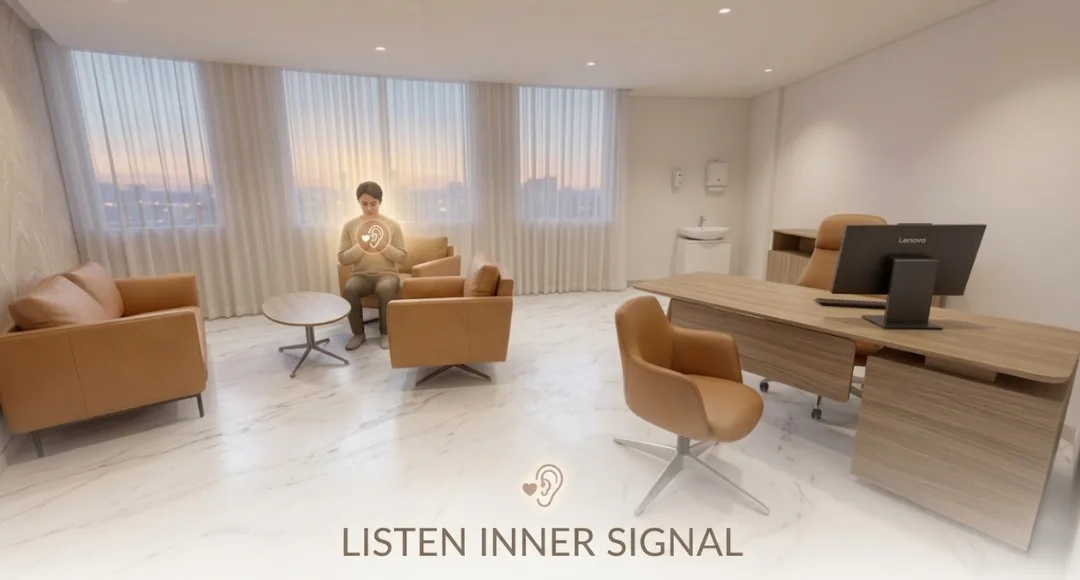
The first and most urgent task when anxiety rises is to regulate your nervous system. When the brain perceives threat (real or imagined), it activates the sympathetic nervous system: heart rate climbs, breath shortens, muscles brace. Your body is preparing to fight or flee something it cannot actually locate. Evidence-based coping tools work by interrupting this loop, and they can be practised anywhere — between back-to-back meetings in DIFC, during a commute down Sheikh Zayed Road, or in the quiet of a Dubai apartment at midnight.
The good news is that effective, evidence-based techniques exist. They don’t require a prescription or a retreat — many can be practised in the minutes before a difficult conversation, or the moments after waking in dread.
Physiological Sigh
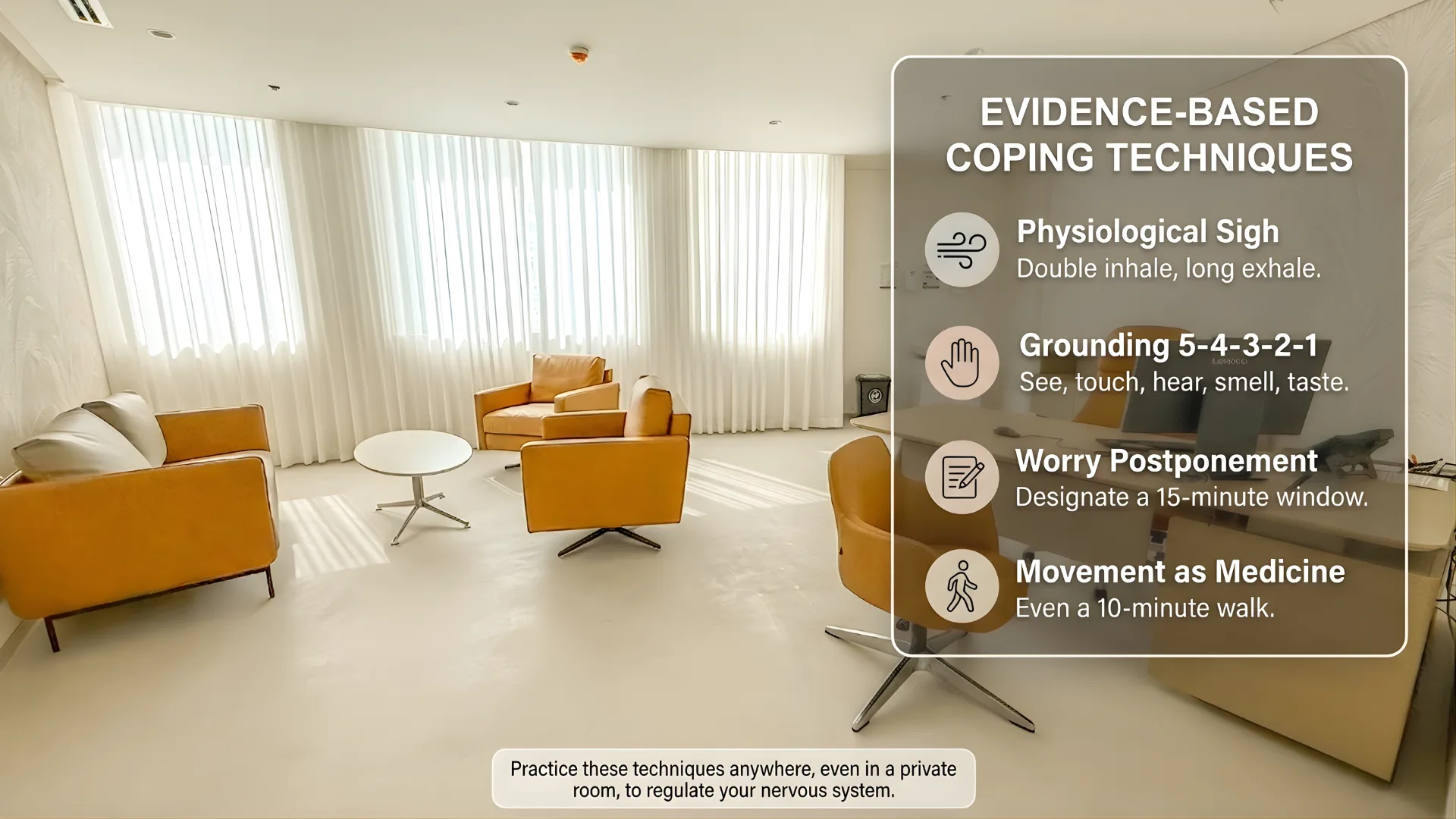
A double inhale through the nose followed by a long exhale deflates over-inflated air sacs in the lungs and rapidly lowers arousal. Two or three repetitions can shift your state noticeably—no app required.
Grounding (5-4-3-2-1)
Name 5 things you can see, 4 you can touch, 3 you can hear, 2 you can smell, and 1 you can taste. This anchors attention to the present and interrupts the spiral of anticipatory thought.
Worry Postponement
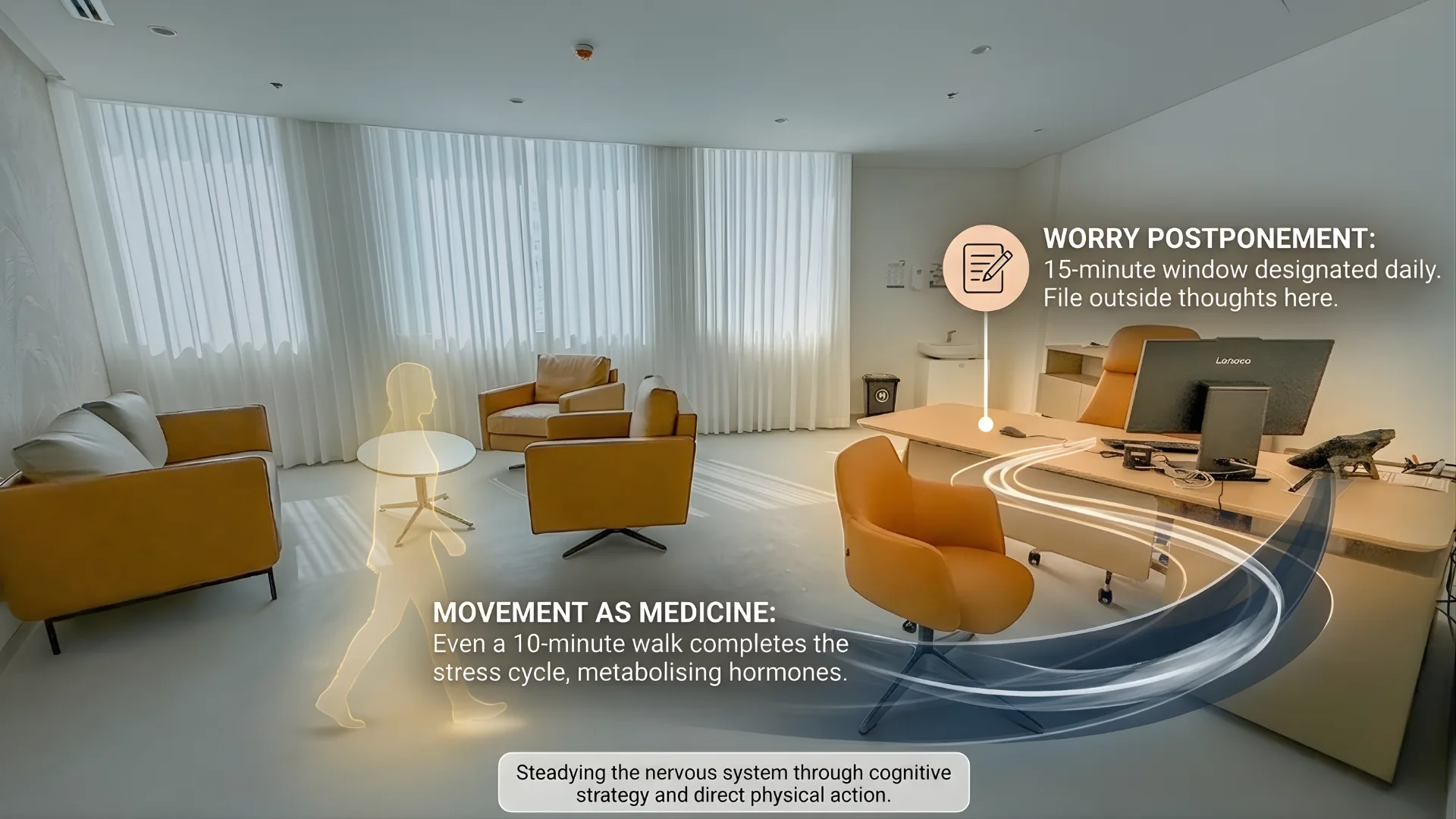
Designate a 15-minute “worry window” each day. When anxious thoughts arise outside of it, note them and defer them. This teaches the brain that these thoughts can wait — because most of them can.
Movement as Medicine
Even a 10-minute walk metabolizes stress hormones circulating in the bloodstream. The body needs to complete the physiological stress cycle—movement is one of the most direct ways to do that.
Beyond Coping: What Is Your Anxiety Really Saying?
There is a perspective in psychotherapy — one with roots in psychodynamic thinking — that treats symptoms not as malfunctions, but as messengers. Anxiety, in this view, is the psyche’s way of flagging something that has not yet been consciously named. This approach is particularly relevant in Dubai, where the pace of life makes it easy to manage symptoms indefinitely while never pausing to ask: what is this really about?
Consider this: you feel a persistent, low-level dread every Sunday evening. The breathing exercises help you fall asleep, but Monday brings it back. Zoom out, and you might find that the anxiety is not about Monday itself — it is pointing toward a deeper conflict. Perhaps a part of you knows that the work you do no longer reflects your values. Perhaps you long for connection that your current life does not offer. Perhaps there is a grief that was never given space. For many expats in Dubai, there is also the particular anxiety of impermanence — a life built in a city you’re not sure you belong to, held together by a residency status and a salary, rather than by roots.
Freud observed that anxiety arises when the ego is caught between two conflicting forces — the impulse to express something, and the learned prohibition against expressing it. More contemporary relational therapists speak of anxiety as the body’s response to an “unmetabolised” experience: something that happened and was never fully processed, now pressing against the membrane of awareness.
The question is not only “how do I calm this feeling?” but equally “what would I discover if I sat with it long enough to understand it?”
This does not mean anxiety is always a symbol to be decoded. Sometimes it is neurobiological, contextual, or an appropriate response to a genuinely demanding life. Cognitive Behavioural Therapy (CBT) — one of the most widely used anxiety treatments in Dubai — works primarily at the level of unhelpful thought patterns and is highly effective too. But for many people, particularly those whose anxiety persists despite years of management, the missing piece is not more strategies. It is curiosity.
“What would you find if you stopped trying to silence anxiety, and started asking it what it wants you to know?”
A psychologist or therapist in Dubai can serve as a guide in this territory — not to tell you what your anxiety means, but to help you develop the capacity to sit with your inner experience without being overwhelmed by it. This process, sometimes called building affect tolerance, allows you to approach the roots of anxiety with something closer to curiosity than dread.
In our experience at Almond Blossoms Wellbeing Center, some of the most significant shifts happen not when patients learn to manage anxiety better, but when they begin to understand why it arose in the first place — and what change it has, quietly, been asking for all along.
Anxiety Treatment in Dubai — Your Questions Answered
What are the most effective coping strategies for anxiety in Dubai?
Evidence-based techniques include the physiological sigh, grounding exercises (5-4-3-2-1), structured worry postponement, and regular movement. These regulate the nervous system in the short term and can be practised between the demands of a busy Dubai schedule. A DHA-licensed psychologist can tailor an approach to your specific triggers and lifestyle.
Why is anxiety so common among expats in Dubai?
Anxiety is particularly prevalent among Dubai expats due to high-performance pressure, distance from family support networks, cultural adjustment, visa dependency, and the relentless pace of the city. Studies suggest over 50% of UAE expats report stress symptoms, many of which overlap with anxiety disorders.
When should I see a psychologist for anxiety in Dubai?
Consider seeking support if anxiety is consistently affecting your sleep, work performance, relationships, or quality of life; if coping strategies are no longer sufficient; or if anxiety has persisted for more than two weeks. You do not need to be in crisis to benefit from therapy—early support typically leads to faster and more complete recovery.
Is anxiety therapy covered by insurance in Dubai?
Many UAE health insurance plans — including Daman, Bupa, AXA, Cigna, MetLife, and NAS — provide some or full coverage for psychological services delivered by a licensed psychologist. Coverage terms vary; confirm with your insurer and the clinic before booking.
What is the difference between CBT and psychodynamic therapy for anxiety?
CBT (Cognitive Behavioural Therapy) focuses on identifying and changing unhelpful thought patterns — structured, typically short-term, and highly effective for symptom reduction. Psychodynamic therapy explores deeper roots of anxiety, including unconscious conflicts and unprocessed experiences. Many clients benefit from both, and our psychologists in Dubai can guide you toward what fits your situation or tailor an approach that combines both.
Ready to Understand Your Anxiety?
Our psychologists and therapists in Dubai specialise in anxiety treatment — from practical coping strategies to deeper psychological insight. We work with expats and UAE residents across Dubai.