If you have PCOS and are struggling to conceive, you may wonder whether PCOS means infertility. It does not. PCOS can interfere with regular ovulation, but many women with PCOS conceive naturally or with appropriate fertility treatment. Dr. Sreelatha explains what PCOS means for fertility and when a gynecology evaluation can help.
What Is PCOS and How Can It Affect Fertility?
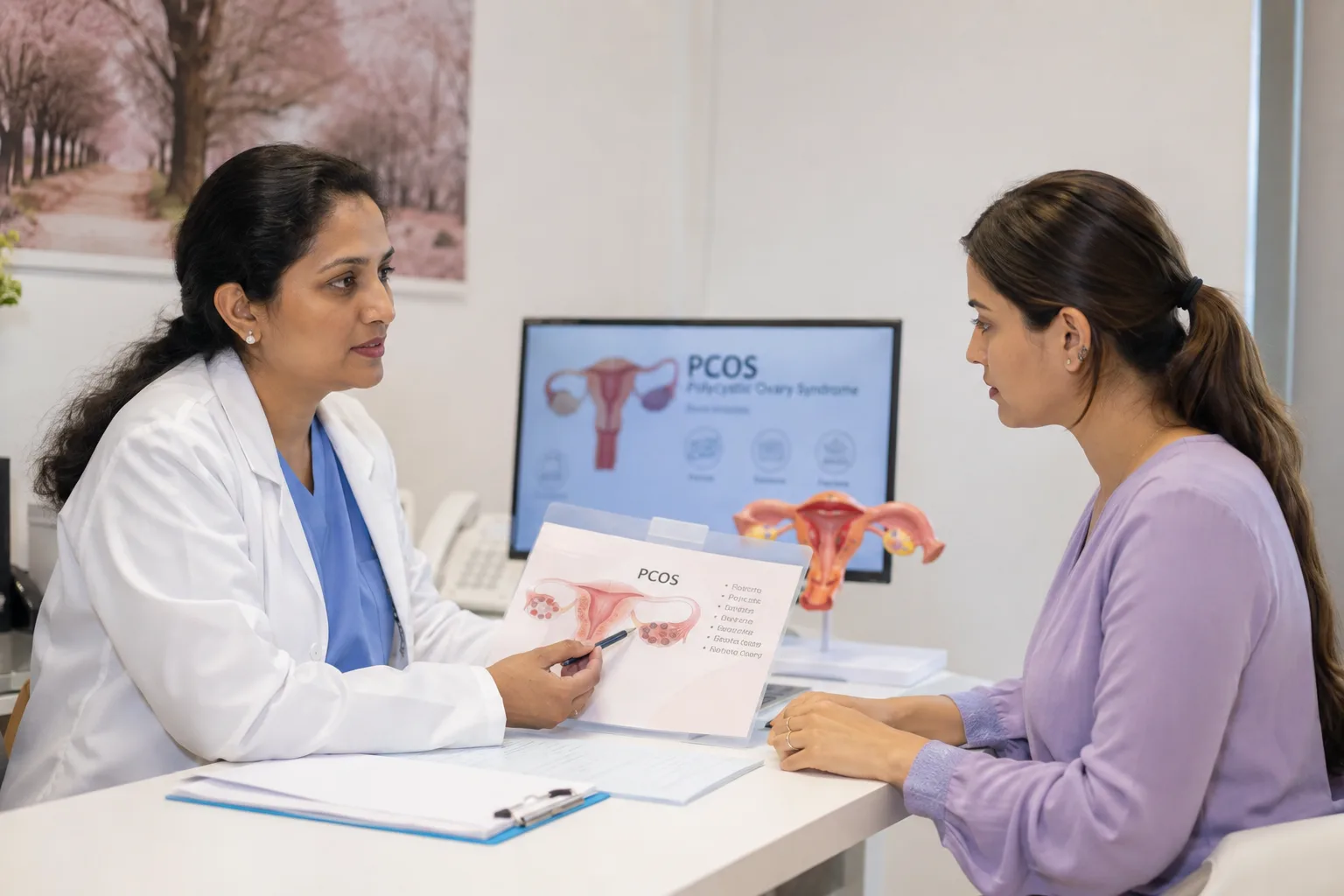
Polycystic ovary syndrome (PCOS) is a hormonal condition that can affect ovulation, menstrual cycles, and metabolism. Despite its name, having PCOS does not mean that you necessarily have ovarian cysts.
One of the main ways PCOS can affect fertility is through irregular or absent ovulation. Ovulation is the release of an egg from the ovary. If ovulation happens infrequently or unpredictably, it can become harder to identify the fertile window and achieve pregnancy.
This is why PCOS is a common cause of ovulatory infertility related to problems releasing an egg.
Importantly, irregular ovulation is not the same as having no chance of pregnancy. Many women with PCOS can conceive when ovulation is appropriately managed. Medical sources also note that PCOS-related infertility can often be treated with ovulation-supporting medicines and, when necessary, assisted reproductive treatments.
Common signs of PCOS
You may experience:
- Irregular or missed periods
- Infrequent ovulation
- Acne or oily skin
- Increased facial or body hair
- Hair thinning
- Weight changes
- Difficulty becoming pregnant
- Signs of insulin resistance or abnormal blood sugar
However, symptoms vary considerably between women. You do not need to have every symptom to have PCOS.
A proper assessment considers your menstrual history, symptoms, hormone levels, and, when appropriate, ultrasound findings. There is no single test that confirms PCOS in every patient

PCOS and Infertility: What Does a Gynecology Evaluation Involve?
If you have PCOS and are trying to conceive, a fertility-focused gynecology consultation can help determine whether irregular ovulation is actually affecting your ability to become pregnant.
Dr. Sreelatha’s approach includes evaluating PCOS and hormonal fertility issues as part of a broader reproductive assessment rather than looking at one symptom in isolation.
1. Your menstrual and fertility history
Your specialist may ask about:
- How frequently your periods occur
- How long your cycles usually last
- Previous pregnancies or miscarriages
- How long you have been trying to conceive
- Previous fertility treatments
- Previous PCOS diagnosis or treatment
This information can provide important clues about whether you are ovulating regularly.
2. Hormonal evaluation
Blood tests may be recommended to understand your reproductive and metabolic health.
Depending on your circumstances, your specialist may evaluate hormones and other markers relevant to ovulation and fertility.
AMH, or anti-Müllerian hormone, is one example. It indicates ovarian reserve, the remaining supply of eggs, but AMH alone cannot tell you whether you will become pregnant.
Other investigations may be recommended based on your individual symptoms and medical history.
3. Ultrasound assessment
A pelvic ultrasound may help your doctor assess the ovaries and uterus.
It can provide information about ovarian appearance, follicles and other reproductive structures. However, an ultrasound finding by itself does not automatically mean that you have PCOS.
4. Fertility assessment for both partners
It is also important not to assume that PCOS is the only possible reason for difficulty conceiving.
Depending on your situation, your specialist may recommend evaluating other fertility factors, including the fallopian tubes and sperm health.
A semen analysis, for example, can assess sperm count, movement and shape.
This broader approach can prevent unnecessary treatment and help your specialist identify the most appropriate next step.
Can You Get Pregnant Naturally With PCOS?
Yes. PCOS does not automatically mean you cannot become pregnant naturally.
The main challenge for many women with PCOS is inconsistent ovulation. If you ovulate regularly enough, natural conception may be possible.
For others, treatment may be recommended to help restore or support ovulation.
The appropriate approach depends on factors such as:
- Your age
- How frequently you ovulate
- How long you have been trying to conceive
- Your ovarian reserve
- Fallopian tube health
- Sperm health
- Other medical conditions
- Previous fertility treatment
This is why there is no single “best PCOS fertility treatment” for everyone.
When should you see a fertility specialist?
You do not necessarily need to wait a full year if you already know you have PCOS and your periods are very irregular or absent.
Earlier evaluation may be appropriate when there is a known condition that can affect fertility. Fertility guidance also generally recommends earlier assessment as maternal age increases.
Speaking with a specialist can help you understand whether you need treatment now or whether monitoring and less-invasive approaches are appropriate.
How Is PCOS-Related Infertility Treated?
Treatment depends on why you are having difficulty conceiving, not simply on the fact that you have PCOS.
Lifestyle and metabolic health
For some women, improving overall metabolic health can support more regular ovulation.
Your doctor may discuss nutrition, physical activity and weight management where relevant. However, PCOS occurs in women of different body sizes, so fertility care should not be reduced to weight alone.
The goal is to address your individual health needs rather than follow a generic PCOS plan.
Ovulation induction
If irregular ovulation is the main fertility issue, your specialist may recommend ovulation induction.
This means using medication to encourage the ovaries to release an egg.
The medication and monitoring schedule depend on your medical history. Some women may need ultrasound monitoring to determine how their ovaries are responding.
IUI
Intrauterine insemination (IUI) is a fertility treatment in which prepared sperm is placed directly into the uterus around the time of ovulation.
IUI may be considered in selected situations when appropriate ovulation can be achieved, and there are no major problems with the fallopian tubes or sperm.
It is not automatically the next step for every woman with PCOS.
IVF and ICSI
In vitro fertilisation (IVF) involves stimulating the ovaries, retrieving eggs, fertilising them with sperm in a laboratory and transferring an embryo to the uterus.
ICSI, or intracytoplasmic sperm injection, is a technique used during IVF in which a single sperm is injected directly into an egg.
IVF may be considered when other approaches have not worked, when additional fertility factors are present, or when your specialist believes it is the most appropriate treatment strategy.
At Almond Blossoms, fertility care includes IVF, ICSI, IUI, and reproductive medicine, allowing treatment to be tailored to the individual’s circumstances rather than assuming that every patient with PCOS needs IVF.
What Dr. Sreelatha Wants Women With PCOS to Know
One of the most important messages is that a PCOS diagnosis should not automatically be interpreted as a diagnosis of infertility.
PCOS can make conception more difficult because ovulation may be irregular. But fertility is influenced by multiple factors, including age, ovarian reserve, fallopian tube health, sperm quality and other reproductive conditions.
Dr. Sreelatha’s profile highlights her work in reproductive endocrinology, PCOS, endometriosis and hormonal fertility issues, alongside individualized fertility treatment.
That individualized approach is particularly important because two women with PCOS can have completely different fertility profiles.
One woman may ovulate occasionally and conceive with minimal intervention. Another may have very infrequent ovulation and need fertility medication. Someone else may have PCOS alongside another fertility factor requiring IUI or IVF.
Fertility treatment is also an emotional experience
PCOS can affect more than reproductive health.
Irregular periods, changes in weight or appearance, fertility uncertainty, and repeated attempts to conceive can contribute to emotional distress. Research and clinical guidance recognize psychological wellbeing as an important part of PCOS care.
This is particularly relevant when fertility treatment becomes prolonged.
At Almond Blossoms, fertility care is integrated with psychological and wellbeing support. That means emotional support can be considered alongside reproductive treatment rather than treated as completely separate from the fertility experience.
For some patients, counselling can provide a space to work through anxiety, relationship pressure, treatment fatigue or the uncertainty that can accompany fertility care.
When Should You Consider a PCOS and Fertility Consultation in Dubai?
Consider speaking with a gynecology or fertility specialist if:
- You have PCOS and are actively trying to conceive.
- Your periods are very irregular or absent.
- You are unsure whether you are ovulating.
- You have been trying to conceive without success.
- You have previously received PCOS treatment but still have fertility concerns.
- You have had previous fertility treatment that did not result in pregnancy.
- You are concerned about your fertility and want an individualized assessment.
You do not need to wait until you feel overwhelmed before asking questions.
A consultation can simply be an opportunity to understand your reproductive health, review your options, and decide what, if anything, should happen next.
Conclusion: PCOS Does Not Define Your Fertility Future
PCOS and infertility are closely connected because PCOS can interfere with ovulation, but PCOS does not mean that pregnancy is impossible.
The right approach depends on your individual reproductive health. A thorough gynecology and fertility evaluation can identify whether irregular ovulation is the main issue and whether you may benefit from ovulation induction, IUI, IVF, ICSI, or another approach.
Dr. Sreelatha Gopalakrishnan specializes in infertility and reproductive medicine at Almond Blossoms, with clinical expertise in PCOS and hormonal fertility issues.
If PCOS has left you uncertain about your fertility options, book a consultation with a fertility specialist at Almond Blossoms in Dubai Healthcare City to discuss your individual situation and the most appropriate next step.
A Consultation in Dubai
→ Website
Frequently Asked Questions (FAQs)
Does PCOS mean I am infertile?
No. PCOS can make pregnancy more difficult because it may cause irregular or absent ovulation, but many women with PCOS become pregnant naturally or with appropriate treatment.
Can PCOS be cured?
There is currently no permanent cure for PCOS, but its symptoms and associated fertility problems can often be managed effectively. Treatment depends on your symptoms, health goals, and whether you are trying to conceive.
Is IVF necessary if I have PCOS?
No. IVF is not automatically necessary for PCOS. Depending on your fertility assessment, your specialist may recommend monitoring, ovulation induction, IUI or another approach before considering IVF.
Can I have PCOS if my periods are regular?
Yes. Regular periods do not necessarily rule out PCOS. Diagnosis is based on a combination of clinical features and appropriate investigations rather than one symptom alone.
Does PCOS affect IVF?
PCOS can influence how the ovaries respond to fertility medication, which is why IVF protocols should be individualized and carefully monitored. Your fertility specialist can assess your specific risks and determine an appropriate stimulation strategy.