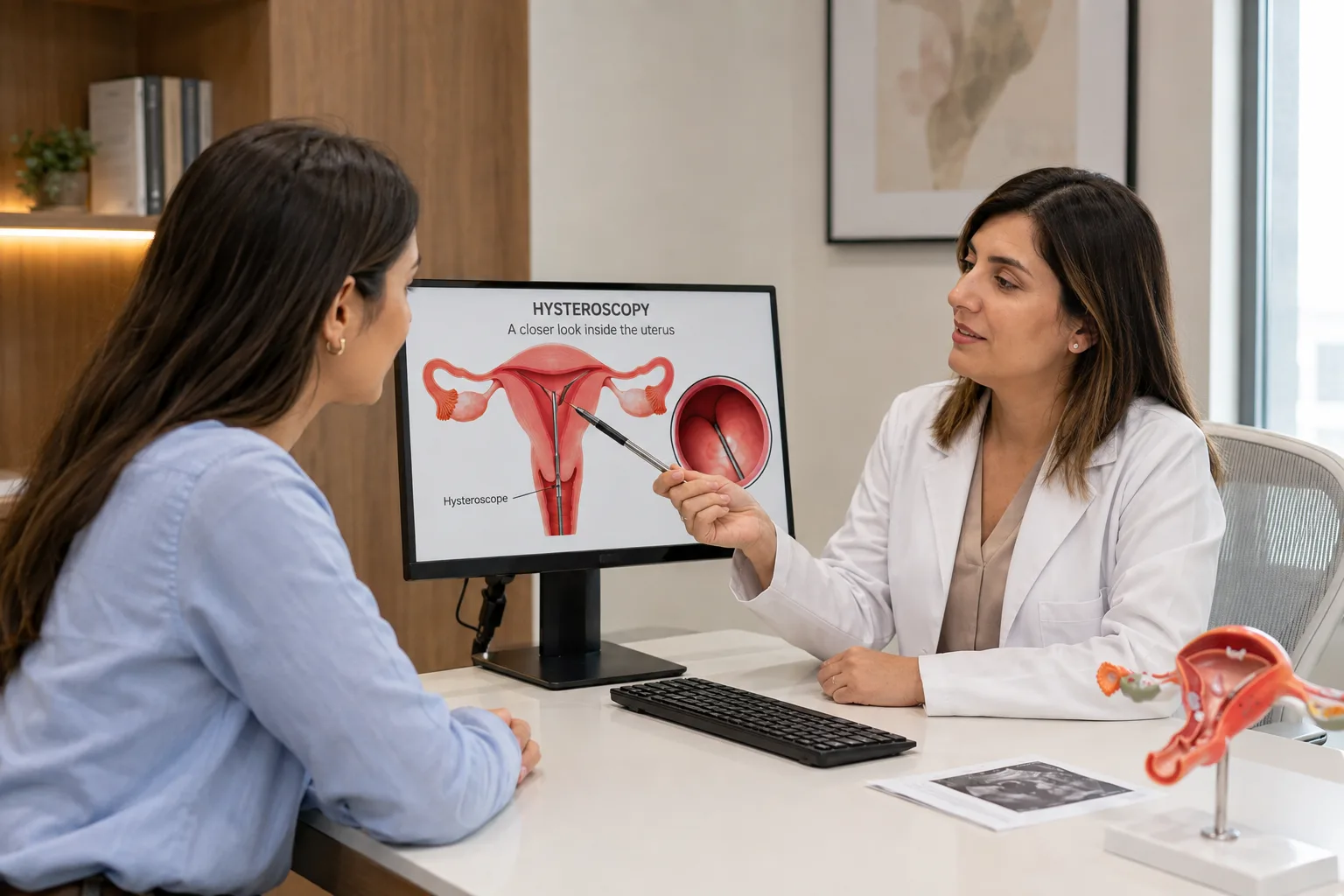
If you are preparing for IVF, your fertility specialist may recommend a hysteroscopy to check the inside of your uterus before embryo transfer. Hysteroscopy uses a small camera to examine the uterine cavity and can identify and sometimes treat problems such as polyps, adhesions, fibroids, or a uterine septum.
For some patients, this evaluation is an important part of preparing the uterus for fertility treatment. However, hysteroscopy is not automatically necessary for everyone before IVF. Your specialist should recommend it based on your medical history, ultrasound findings, previous treatment outcomes, and individual risk factors.
What Is Hysteroscopy and Why Is It Used in Fertility Treatment?
Hysteroscopy is a minimally invasive procedure that allows a doctor to look directly inside the uterus using a thin telescope with a camera.
Unlike an ultrasound, which creates images from outside the uterine cavity, hysteroscopy provides a direct view of the uterine lining and cavity. It can therefore help identify abnormalities that could potentially interfere with implantation or pregnancy.
The procedure may be used for both diagnosis and treatment of certain conditions affecting the uterine cavity. The American Society for Reproductive Medicine (ASRM) describes hysteroscopy as the definitive method for diagnosing and treating intrauterine pathology, although less-invasive tests may be appropriate as an initial evaluation in many patients.
At Almond Blossoms Fertility & Well-being Centre in Dubai, hysteroscopy is part of the clinic’s fertility and diagnostic services. The centre also has specialists with expertise in hysteroscopy and uterine-factor infertility, including Professor Attilio Di Spiezio Sardo, whose clinical focus includes diagnostic and operative hysteroscopy and fertility-preserving uterine surgery.

What can hysteroscopy detect?
Depending on your circumstances, hysteroscopy may identify:
- Endometrial polyps – small growths arising from the uterine lining
- Submucosal fibroids – fibroids that grow into and distort the uterine cavity
- Intrauterine adhesions – bands of scar tissue inside the uterus
- Uterine septum – a wall of tissue that partially or completely divides the uterine cavity
- Abnormalities in the shape or structure of the uterine cavity
- Retained tissue or other abnormalities in selected situations
Some of these findings can be treated during the same hysteroscopic procedure, depending on their size, location and your doctor’s assessment.
Why Is Hysteroscopy Recommended Before IVF?
The goal is not simply to “do another test.” The purpose is to make sure that the uterine cavity has been appropriately assessed before an embryo is transferred.
During IVF (in vitro fertilisation), eggs are collected and fertilised in a laboratory to create embryos. An embryo is then transferred into the uterus.
Because implantation occurs inside the uterine cavity, abnormalities in that cavity may be relevant to fertility treatment.
1. It can identify problems that affect the uterine cavity
Polyps, adhesions, cavity-distorting fibroids, and some uterine structural abnormalities can alter the shape or environment of the cavity.
If your doctor suspects one of these conditions, hysteroscopy may provide a more direct assessment than imaging alone. Almond Blossoms notes that transvaginal ultrasound, saline sonohysterography, and other imaging tests can all play roles in evaluating the uterus, while hysteroscopy allows direct diagnosis and treatment of intrauterine pathology.
2. It may allow treatment of a problem before embryo transfer
One of the advantages of hysteroscopy is that it can sometimes move from diagnosis to treatment during the same procedure.
For example, depending on the findings, a specialist may be able to remove:
- A uterine polyp
- A cavity-distorting submucosal fibroid
- Intrauterine scar tissue
- Certain congenital abnormalities such as a uterine septum
This does not mean that removing every abnormality automatically improves IVF success. The evidence varies depending on the condition, and treatment should be individualized. For example, Almond Blossoms considers hysteroscopic treatment of cavity-distorting fibroids reasonable in selected infertile patients, while evidence is insufficient to recommend surgery simply for non-cavity-distorting fibroids without other indications.
3. It may be particularly relevant after previous IVF failure
Your specialist may consider hysteroscopy if you have experienced recurrent implantation failure, meaning repeated IVF attempts in which embryos were transferred but pregnancy was not achieved.
Recent Almond Blossoms guidance states that repeat uterine-cavity evaluation, including hysteroscopy, may reasonably be considered in patients with recurrent implantation failure because some uterine abnormalities may be identified and treated. At the same time, the evidence does not support performing hysteroscopy routinely for every person with previous IVF failure.
This distinction is important: hysteroscopy is a tool for investigating a possible problem, not a guaranteed way to increase IVF success.
Who May Need Hysteroscopy Before IVF?
There is no single rule that says every IVF patient needs hysteroscopy.
Your fertility specialist may be more likely to recommend it if you have:
- An abnormal ultrasound or other uterine imaging result
- Suspected polyps or fibroids
- A history of intrauterine surgery or procedures
- Previous miscarriage, particularly recurrent pregnancy loss
- Previous treatment involving the uterus where adhesions are a concern
- Repeated unsuccessful embryo transfers
- Suspected uterine structural abnormalities
- Unexplained abnormal uterine bleeding
- Findings that require direct assessment of the uterine cavity
For example, Almond Blossoms notes that uterine abnormalities are more common in women with abnormal uterine bleeding and recommends a systematic fertility evaluation using appropriate imaging and other tests based on the individual clinical situation.
Does everyone need hysteroscopy before IVF?
No.
This is one of the most important points to understand.
If your ultrasound and other fertility investigations show a normal uterine cavity and you have no clinical reason to suspect an intrauterine problem, your doctor may decide that hysteroscopy is unnecessary.
Hysteroscopy is more invasive than an ultrasound and may not be the first test used when there is no specific indication. Almond Blossoms specifically recognizes that hysteroscopy can be more invasive and costly than less-invasive methods such as hysterosalpingography (HSG) or saline sonohysterography.
Your fertility specialist should therefore consider the whole clinical picture, rather than recommending the procedure simply because you are undergoing IVF.
What Happens During a Hysteroscopy?
Knowing what to expect can make the procedure feel less intimidating.
During hysteroscopy, a thin instrument called a hysteroscope is introduced through the vagina and cervix into the uterus. A camera allows the specialist to examine the uterine cavity.
Depending on the type of hysteroscopy and the reason for the procedure, it may be performed as an office procedure or as an operative procedure when treatment is required.
Diagnostic hysteroscopy
A diagnostic hysteroscopy is primarily used to examine the uterine cavity.
It may be considered when your doctor needs a closer look after an ultrasound or other fertility investigation.
Operative hysteroscopy
An operative hysteroscopy is performed when a problem needs treatment.
Specialized instruments can be passed through the hysteroscope to treat selected abnormalities, such as removing a polyp or certain fibroids.
The exact approach depends on the abnormality, its size and location, your medical history and the specialist’s assessment.
When is hysteroscopy performed?
Timing depends on your menstrual cycle, the reason for the procedure and your fertility treatment plan.
Almond Blossoms notes that hysteroscopy is ideally performed when the endometrial lining is relatively thin, often shortly after menstruation, because a thinner lining can improve visualization of the uterine cavity.
Your clinic will provide specific instructions about timing, medications, preparation, and whether anesthesia or pain relief is appropriate.
Does Hysteroscopy Improve IVF Success?
This is perhaps the most important question for anyone considering the procedure.
Hysteroscopy can identify and treat certain uterine abnormalities that may be relevant to fertility, but it does not guarantee a higher IVF success rate.
The effect depends heavily on what is found.
For example, treating a cavity-distorting abnormality may be beneficial in an appropriately selected patient. But performing hysteroscopy in someone with a completely normal uterine cavity does not automatically improve the chance of pregnancy.
Research into hysteroscopy before IVF has produced different results depending on the patient population and clinical situation. Recent guidance on recurrent implantation failure emphasizes individualized assessment and notes that some studies have found abnormalities during hysteroscopy while randomized evidence has not consistently demonstrated improved outcomes from routine hysteroscopy.
This is why a responsible fertility clinic should explain why the procedure is being suggested in your particular case, rather than presenting it as something every IVF patient must undergo.
What if a problem is found?
Your specialist may discuss whether treatment is appropriate before continuing with IVF.
The timing of your next treatment cycle can depend on:
- What was found
- Whether treatment was performed
- The extent of the procedure
- How your uterus heals
- Your overall fertility plan
Hysteroscopy vs Ultrasound: What’s the Difference?
If you have already had a transvaginal ultrasound, you may wonder why another uterine assessment is necessary.
The two tests provide different types of information.
| Test | What it does |
| Transvaginal ultrasound | Uses sound waves to examine the uterus, ovaries, and surrounding reproductive structures |
| Saline sonohysterography | Uses ultrasound after saline is introduced into the uterus to outline the uterine cavity |
| HSG | Uses X-ray imaging and contrast to evaluate the uterine cavity and whether the fallopian tubes are open |
| Hysteroscopy | Uses a camera to directly view the inside of the uterine cavity and can allow treatment of selected abnormalities |
Almond Blossoms notes that saline sonohysterography can provide detailed information about intrauterine pathology, while hysteroscopy has the additional advantage of allowing direct diagnosis and treatment.
So, having an ultrasound does not necessarily mean that hysteroscopy is either required or redundant. Your specialist may recommend one, another, or a combination depending on what needs to be investigated.
How Does Hysteroscopy Fit Into Your IVF Plan?
Fertility treatment is rarely just one procedure.
Your treatment plan may include several stages, such as:
- Fertility assessment – reviewing your medical history and reproductive goals.
- Hormonal and ovarian assessment – evaluating factors such as ovarian reserve when clinically appropriate.
- Uterine evaluation – using ultrasound or other tests when indicated.
- Hysteroscopy – if direct assessment or treatment of the uterine cavity is appropriate.
- IVF or ICSI – fertilising eggs in the laboratory.
- Embryo culture and assessment – monitoring embryo development.
- Genetic testing when indicated – such as PGT, or preimplantation genetic testing, for specific genetic or chromosomal considerations.
- Embryo transfer – placing a selected embryo into the uterus.
- Pregnancy follow-up – monitoring the early pregnancy.
At Almond Blossoms, hysteroscopy sits within a broader fertility programme that includes IVF and ICSI, fertility preservation, genetic testing and other reproductive services.
Don’t overlook the emotional side of fertility treatment
Tests and procedures can create additional uncertainty, particularly if you have already experienced unsuccessful treatment or pregnancy loss.
That is why fertility care should consider more than the physical aspects of treatment. Almond Blossoms combines fertility medicine with psychological and wellbeing support, including individual and couples therapy.
If the prospect of another procedure is causing significant anxiety, discussing those concerns with your fertility team or a qualified mental health professional can be a useful part of preparing for treatment.
Conclusion: Is Hysteroscopy Right for You Before IVF?
Hysteroscopy can be a valuable fertility investigation when your specialist needs a direct view of the uterine cavity or suspects a problem that could affect treatment. It may also allow certain abnormalities to be treated without conventional abdominal surgery.
However, it is not a routine requirement for every person undergoing IVF. The decision should be based on your ultrasound findings, fertility history, previous IVF outcomes, pregnancy history and overall treatment plan.
At Almond Blossoms Fertility & Well-being Centre in Dubai, fertility care combines reproductive medicine, hysteroscopic expertise and emotional wellbeing support so that treatment decisions can be made with both medical precision and appropriate psychological support. The centre’s team includes specialists in reproductive medicine and hysteroscopy, including internationally recognized hysteroscopic surgeon Professor Attilio Di Spiezio Sardo.
If you are preparing for IVF and have been advised to consider hysteroscopy, book a consultation with a fertility specialist at Almond Blossoms to understand why it may be appropriate for your individual situation and how it could fit into your treatment plan.
A Consultation in Dubai
→ Website
Frequently Asked Questions (FAQs)
Is hysteroscopy necessary before IVF?
No, not for everyone. Hysteroscopy may be recommended when there is a suspected uterine abnormality, previous implantation failure, recurrent pregnancy loss, abnormal imaging, or another clinical reason to examine the uterine cavity directly.
Can hysteroscopy increase IVF success?
Hysteroscopy itself does not guarantee a higher IVF success rate. Its potential benefit comes from identifying and, when appropriate, treating abnormalities inside the uterine cavity. Evidence varies according to the condition and patient group, so your specialist should assess whether it is appropriate for you.
What can hysteroscopy find before IVF?
It can identify abnormalities such as endometrial polyps, intrauterine adhesions, cavity-distorting fibroids and some uterine structural abnormalities, including a uterine septum. Selected abnormalities can sometimes be treated during hysteroscopy.
Is hysteroscopy painful?
The experience varies depending on the type of hysteroscopy, the individual patient, and whether treatment is required. Some diagnostic hysteroscopies can be performed in an office setting, while operative procedures may require different pain-relief or anesthesia arrangements. Your specialist should explain the planned approach beforehand.
How soon can I have IVF after hysteroscopy?
There is no single timeframe for everyone. It depends on what was found, whether treatment was performed,d and how your uterus recovers. Your fertility specialist will advise when it is appropriate to proceed with ovarian stimulation or embryo transfer.