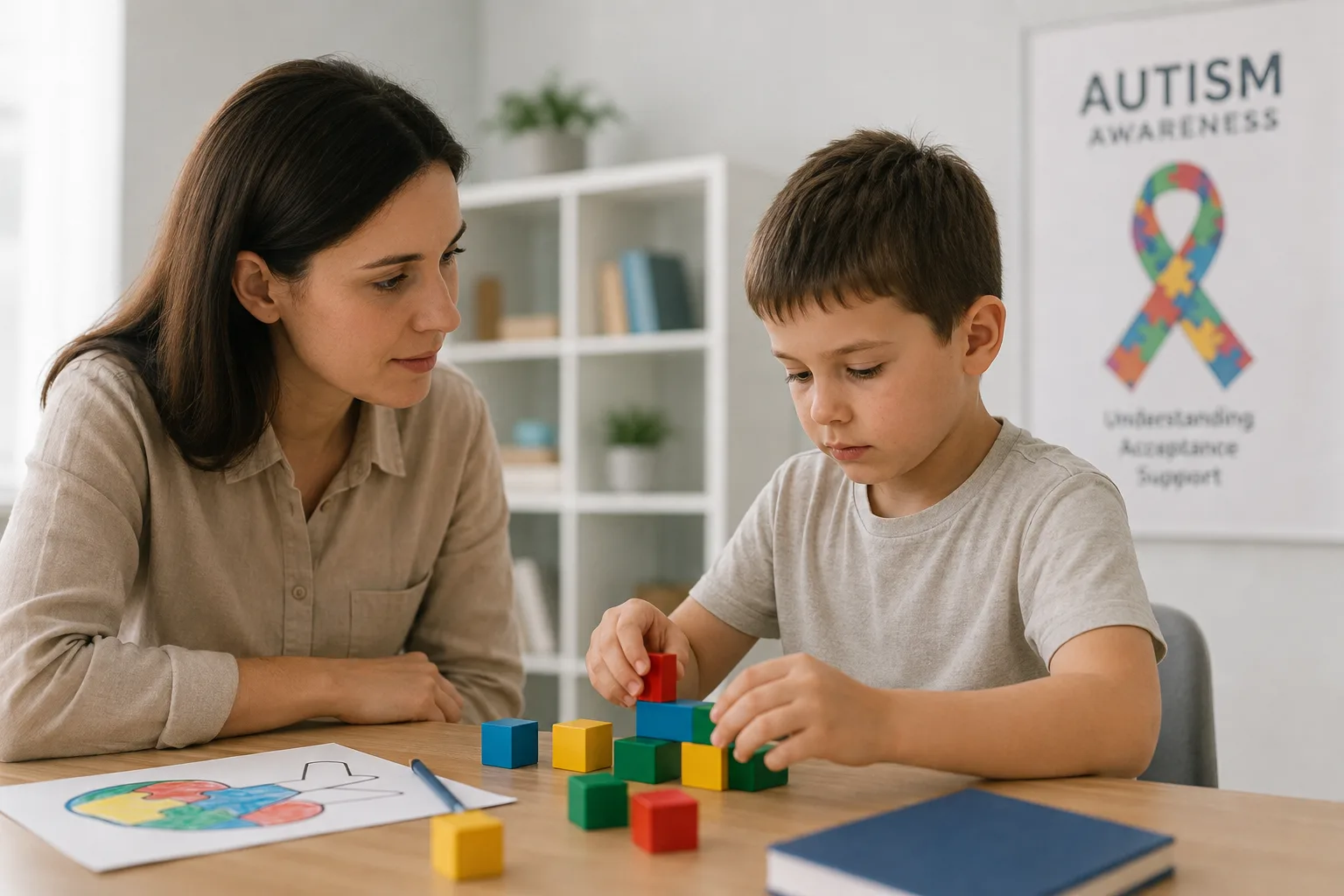
If you are wondering what Autism Spectrum Disorder (ASD) is, you are not alone. Autism is a developmental condition that can affect communication, social interaction, behaviour, learning, and sensory experiences. Because autism exists on a spectrum, every autistic person can have a different combination of strengths, challenges, and support needs.
What Is Autism Spectrum Disorder?
Autism spectrum disorder (ASD) is a neurological and developmental disorder that affects how people interact with others, communicate, learn, and behave. Although autism can be diagnosed at any age, it is described as a “developmental disorder” because symptoms generally appear in the first two years of life.
The word “spectrum” is important. Autism does not look the same in everyone. One person may have significant communication difficulties and need substantial daily support, while another may speak fluently, live independently, and primarily experience challenges with social communication or sensory processing.
Autism is generally understood as a lifelong developmental condition rather than an illness that simply appears at a particular age. Although characteristics often become noticeable in early childhood, some people are diagnosed much later, such as in adolescence or adulthood.
It is also important not to assume that autism means a person lacks abilities. Autistic people can have significant strengths, including strong attention to detail, memory, focused interests or particular abilities in areas such as mathematics, music, art or visual learning
At Fertility & Wellbeing Center in Dubai, the Well-being Centre includes support for neurodevelopmental conditions such as ADHD and ASD, alongside psychological care for individuals and families.

What Are the Signs and Symptoms of Autism Spectrum Disorder?
Autism characteristics generally fall into two broad areas:
- Differences in social communication and interaction
- Restricted or repetitive behaviours, interests or activities
Not everyone with ASD experiences every characteristic, and the intensity can vary considerably.
Social communication and interaction
Some children or adults with autism may experience difficulties with:
- Maintaining eye contact
- Responding consistently when their name is called
- Understanding facial expressions or body language
- Starting or maintaining conversations
- Understanding sarcasm, humour or indirect communication
- Sharing interests or emotions with other people
- Developing or maintaining friendships
- Using gestures such as pointing or waving
- Understanding social expectations
For example, a child may be able to speak but find it difficult to participate in back-and-forth conversation. Another person may communicate very comfortably but struggle to understand subtle social cues.
Repetitive behaviours and focused interests
Other characteristics can include:
- Repeating words or phrases
- Repetitive movements such as hand flapping or rocking
- Arranging objects in a particular order
- Strong attachment to routines
- Becoming distressed when routines change
- Developing highly focused interests
- Repeating the same activities or play patterns
- Focusing strongly on specific parts of objects
The CDC also identifies differences in responses to sounds, smells, tastes, textures, sights, or other sensory experiences among characteristics that can occur in autistic people.
Sensory differences
Sensory processing can be an important part of autism.
You may notice that a child or adult seems unusually sensitive to:
- Loud or unexpected sounds
- Bright lights
- Certain fabrics or clothing
- Particular smells
- Food textures
- Physical touch
- Crowded or busy environments
Some people may instead seek particular sensory experiences.
These characteristics do not automatically mean someone has autism. Similar behaviours can occur for many other reasons, which is why professional assessment is important rather than relying on an online checklist.
When Do Signs of Autism Usually Appear?
Autism characteristics often become noticeable during the first few years of life, although the timing varies from person to person.
Some children show developmental differences during infancy or toddlerhood. Others may initially appear to be developing typically and become more noticeably different as social and communication demands increase.
Possible early signs can include:
- Limited or inconsistent eye contact
- Not responding to their name
- Delayed speech or language development
- Limited use of gestures
- Less interest in social interaction
- Repetitive movements
- Repetitive play
- Strong distress when routines change
- Unusual reactions to sounds, textures, or other sensory experiences
However, developmental milestones are not diagnostic on their own.
A child who does not make much eye contact, for example, does not necessarily have ASD. Similarly, a child who prefers routine may simply have an individual temperament.
Can autism be diagnosed in adults?
Yes. Autism can be diagnosed in adulthood.
Some adults reach adulthood without an autism diagnosis because their characteristics were subtle, they developed strategies to manage social situations, or their difficulties were previously attributed to another condition.
Adult assessment can be more complex because characteristics of ASD can overlap with conditions such as anxiety or ADHD. A professional assessment may explore current communication and social experiences as well as developmental history. If you are an adult in Dubai questioning whether autism could explain long-standing difficulties with communication, relationships, sensory experiences, or routines, consider discussing your concerns with a qualified professional experienced in neurodevelopmental assessment.
What Causes Autism Spectrum Disorder?
There is no single known cause of Autism Spectrum Disorder.
Current evidence indicates that autism is complex and that multiple genetic and environmental factors may influence brain development. Having a particular risk factor does not mean that a person will develop autism.
Research has identified associations with factors such as:
- Having a close family member with ASD
- Certain genetic conditions
- Very low birth weight
- Older parental age
However, these factors are not a simple explanation for why one individual is autistic, and another is not. Researchers continue to study how different genetic and developmental factors interact.
Is autism caused by vaccines?
No. Current evidence does not support a link between vaccines and autism.
Large bodies of research have found no causal relationship between vaccination and ASD. The study that originally generated widespread concern about a vaccine-autism connection was later retracted because of serious problems with its methodology.
Understanding the evidence can help families make healthcare decisions based on reliable information rather than fear or misinformation.
How Is Autism Spectrum Disorder Diagnosed?
There is no blood test or single medical test that can diagnose autism. Diagnosis is based primarily on developmental history, behaviour, and clinical assessment.
A comprehensive evaluation may consider:
- Developmental history – how communication, learning, and social skills developed over time.
- Social communication – how the person interacts and communicates with others.
- Behavioural patterns – including repetitive behaviours and focused interests.
- Sensory experiences – how the person responds to different sensory input.
- Daily functioning – how characteristics affect school, work, relationships or everyday activities.
- Family history – relevant developmental and medical information.
- Other possible conditions – symptoms may overlap with ADHD, anxiety, language disorders or other developmental conditions.
For children, parents or caregivers often provide important information about early development. Teachers or other professionals may also contribute observations.
For adults, clinicians may explore childhood experiences and, when appropriate, speak with family members who can provide information about early development.
Why professional assessment matters
It can be tempting to use an online autism test and treat the result as a diagnosis. Screening tools can sometimes indicate that further assessment may be useful, but they cannot replace a professional evaluation.
An accurate assessment can help clarify whether the person’s experiences are consistent with ASD or another condition and what type of support may be appropriate.
What Support Is Available for Autism in Dubai?
There is no single treatment that is appropriate for every autistic person. Support should be based on the individual’s characteristics, strengths, challenges, age, and goals.
The aim is generally to improve functioning, communication, wellbeing, and quality of life rather than to try to make someone conform to a particular idea of how they should behave.
Depending on individual needs, support may involve:
- Psychological support
- Behavioural and communication interventions
- Speech and language support
- Occupational therapy
- Educational support
- Social skills support
- Family counselling
- Support for anxiety, stress or emotional difficulties
- Psychiatric care when clinically appropriate
Early identification can be particularly valuable for children because it can allow families to access appropriate developmental and educational support sooner.
Supporting the whole family
An autism diagnosis can bring relief and clarity, but it can also raise questions about school, relationships, parenting, communication and the future.
Parents may experience anxiety, uncertainty or emotional exhaustion while trying to understand their child’s needs. Adults receiving a diagnosis may also process many years of experiences differently after gaining a better understanding of themselves.
This is where psychological support can be valuable.
The Well-being Centre uses a multidisciplinary approach involving psychologists, psychiatrists, neuropsychologists and mental health professionals, with care available for neurodevelopmental conditions including ASD.
For families who are also navigating fertility treatment, pregnancy or postpartum changes, having psychological care available alongside medical care can provide a more connected approach to wellbeing. Almond Blossoms integrates fertility and psychological services under one centre.
Autism Spectrum Disorder and Mental Wellbeing
Autism itself is not a mental health disorder. However, autistic people can also experience mental health difficulties, including anxiety, depression, stress or sleep problems. These challenges can sometimes become more noticeable when someone faces major life changes.
For example, an autistic adult may experience additional stress when:
- Starting a new job
- Moving to a new country such as the UAE
- Entering a relationship
- Becoming a parent
- Managing fertility treatment
- Experiencing pregnancy or postpartum changes
- Adjusting to unfamiliar environments
Psychological care can focus on the person’s individual needs rather than assuming that every autistic person requires the same type of therapy.
For couples and families, counselling may also help improve communication and develop practical strategies for managing stress together.
Almond Blossoms’ integrated model is particularly relevant for people who are navigating both reproductive health and emotional wellbeing, with fertility specialists and mental health professionals working within the same centre.
Conclusion: Understanding Autism With the Right Support
Autism Spectrum Disorder is a complex developmental condition, and no two autistic people are exactly alike. Understanding the spectrum means looking beyond a checklist of symptoms and considering the person’s communication style, strengths, sensory experiences, relationships, daily functioning, and individual support needs.
If you or your child is showing characteristics that concern you, an online checklist should not be used as a diagnosis. A qualified professional can provide a more complete assessment and help you understand what support may be appropriate.
At Fertility & Wellbeing Center in Dubai, the Well-being Centre provides psychological care for neurodevelopmental conditions including ASD, alongside broader mental health and family support.
If you would like professional guidance about autism, mental wellbeing, or emotional concerns alongside your fertility journey, book a consultation with the Almond Blossoms team.
A Consultation in Dubai
→ Website
Frequently Asked Questions (FAQs)
What is Autism Spectrum Disorder in simple words?
Autism Spectrum Disorder is a neurodevelopmental condition that can affect communication, social interaction, behaviour, learning and sensory experiences. It is called a spectrum because autistic people can have very different strengths, characteristics and support needs.
What are the first signs of autism?
Early signs can include limited eye contact, not responding consistently to a name, delayed language, reduced use of gestures, repetitive behaviours, strong attachment to routines, and unusual sensory responses. These signs alone do not confirm autism.
Can autism be diagnosed in adults?
Yes. Some people are diagnosed during adulthood. Adult assessment may examine current social communication, repetitive behaviours, sensory experiences, and developmental history.
Is autism a mental illness?
No. Autism is a neurodevelopmental condition rather than a mental illness. However, autistic people can also experience mental health conditions such as anxiety or depression and may benefit from psychological support.
Is there a cure for Autism Spectrum Disorder?
No medication or treatment eliminates autism. Support focuses on individual needs, improving communication and daily functioning, addressing co-occurring difficulties, and supporting quality of life.