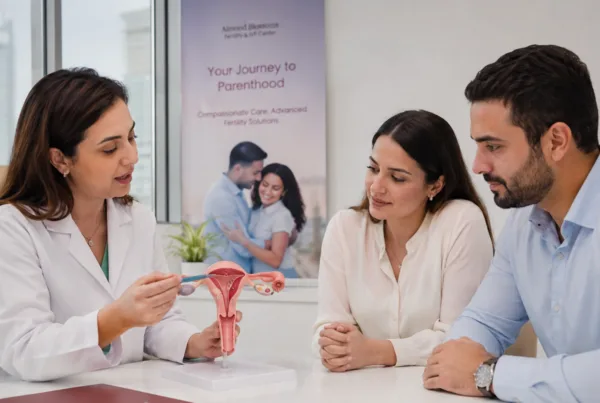
Fertility treatment can help individuals and couples address medical conditions that make it difficult to conceive. At Almond Blossoms Fertility & Well-being Centre in Dubai Healthcare City, fertility treatment is tailored to the underlying cause of infertility, age, reproductive history, and individual treatment goals.
Depending on your fertility assessment, treatment may include fertility medications, ovulation induction, intrauterine insemination (IUI), in vitro fertilisation (IVF), intracytoplasmic sperm injection (ICSI), fertility preservation or other reproductive treatments.
If you have been trying to conceive without success, have irregular ovulation, PCOS, endometriosis, blocked fallopian tubes, recurrent pregnancy loss, or male-factor fertility concerns, a fertility assessment can help identify appropriate treatment options.
Book a fertility consultation in Dubai to discuss your individual fertility treatment options with a specialist.
What Does Infertility Treatment Mean?
Infertility treatment means medical or assisted reproductive treatment used to help individuals or couples achieve pregnancy when conception has not occurred naturally. Depending on the cause, infertility treatment may include medication, ovulation induction, IUI, IVF, ICSI, or other fertility procedures. The appropriate treatment depends on factors such as age, reproductive history, ovarian function, sperm health, and the underlying cause of infertility.

What Is Infertility and When Should Couples Seek Help?
What Is Considered Infertility?
Infertility is clinically defined as the inability to conceive after 12 months of regular, unprotected intercourse. For women over 35, that window shortens; specialists typically recommend seeking an evaluation after just six months of trying.
It’s important to understand that infertility isn’t a single condition. It’s a symptom of an underlying issue, which means it can often be identified, treated, and overcome.
How Long Should Couples Try Before Seeing a Fertility Specialist?
There’s no single answer, but here are the general guidelines most reproductive endocrinologists recommend:
- Under 35: Try naturally for 12 months before seeking specialist advice
- 35 to 40: Seek evaluation after 6 months
- Over 40: Consult a fertility specialist immediately
- Any age: Seek help sooner if you have known risk factors, irregular periods, previous pelvic infections, prior miscarriages, or a history of reproductive conditions
Don’t wait if something feels wrong. Early assessment rarely hurts and often helps.
Common Signs of Infertility in Women
Many women have no obvious symptoms, which is part of what makes infertility so confusing and emotionally difficult. However, some signs may point to an underlying issue:
- Irregular, absent, or very painful periods
- Hormonal symptoms such as unexplained weight gain, acne, or excess facial hair
- History of pelvic inflammatory disease or endometriosis
- Recurrent miscarriage
- Pain during intercourse
Common Signs of Male Infertility
Male infertility is often invisible without testing, but possible indicators include:
- A prior history of testicular injury, surgery, or undescended testicles
- Hormonal symptoms such as changes in sexual function or low libido
- Swelling or discomfort in the testicular area
- Previous diagnosis of sexually transmitted infections
What Is Secondary Infertility?
Secondary infertility, the inability to conceive again after one or more successful pregnancies , affects many couples who are blindsided by it. It’s just as real and just as treatable as primary infertility. Age, changes in reproductive health, or new underlying conditions are common contributors.
Age and Fertility Decline
Age is one of the most significant factors in fertility. A woman’s egg quality and ovarian reserve naturally decline with age, particularly after 35, and more rapidly after 40. Men also experience a gradual decline in sperm quality over time, though typically at a slower rate.
Understanding this doesn’t mean hope is lost. It means that earlier intervention, when appropriate, can make a meaningful difference.
| Fertility Treatment | Commonly Considered For | How It Works |
|---|---|---|
| Fertility medication | Ovulation problems | Helps regulate or stimulate ovulation |
| Ovulation induction | Irregular or absent ovulation | Stimulates egg development and ovulation |
| IUI | Selected cases of unexplained or mild infertility | Places prepared sperm directly into the uterus |
| IVF | Tubal, age-related, unexplained and other infertility factors | Eggs are retrieved, fertilised, and embryos transferred |
| ICSI | Certain male-factor infertility cases | A sperm is injected directly into an egg |
| PGT | Selected IVF cases involving genetic/chromosomal considerations | Embryos are tested before transfer |
| Egg freezing | Fertility preservation | Eggs are retrieved and frozen for potential future use |
Is Infertility Curable?
Infertility does not have one universal treatment or outcome because it can result from many different conditions. Some causes of infertility can be treated or corrected, while others may require assisted reproductive treatments such as IUI or IVF. In some cases, fertility preservation or donor-assisted options may also be discussed.
The first step is identifying the factors affecting conception through an appropriate fertility assessment.
Pregnancy Options for Infertile Couples
- fertility medication
- ovulation induction
- IUI
- IVF
- ICSI
- fertility preservation
- donor options where clinically/legal appropriate
- personalised treatment
Treatment for Infertility: What Are the Options?
Infertility treatment depends on the cause and may involve medication, ovulation induction, IUI, IVF, ICSI, surgery for selected conditions, or fertility preservation. Both partners may need assessment because infertility can involve female factors, male factors, or a combination of factors.
How Fertility Treatment Helps Couples Conceive
Fertility treatment works by identifying and addressing the specific barrier preventing conception, whether that’s an ovulation problem, a sperm quality issue, a structural blockage, or implantation failure.
Supporting Ovulation and Egg Release
For women who aren’t ovulating regularly, fertility medications can stimulate the ovaries to produce and release eggs on a predictable cycle. This dramatically improves the chances of conception, either naturally or through assisted procedures.
Enhancing Sperm Quality and Fertilisation
Treatments like ICSI (intracytoplasmic sperm injection) allow embryologists to select the best-quality sperm and inject it directly into an egg, bypassing the need for sperm to swim and penetrate independently. This is a game-changer for severe male infertility.
Helping Embryos Implant Successfully
Some couples conceive but cannot maintain a pregnancy due to implantation failure. Fertility treatments can assess embryo quality through preimplantation genetic testing (PGT) and identify the most viable embryos for transfer, increasing implantation success rates.
Overcoming Blocked Fallopian Tubes
When fallopian tubes are blocked or damaged, sperm cannot reach an egg. IVF bypasses this entirely; eggs are retrieved directly from the ovaries, fertilised in a laboratory, and the resulting embryo is transferred directly into the uterus.
Treating Hormonal Imbalances
Hormone therapy can restore the delicate hormonal environment needed for conception and a healthy early pregnancy. This may involve thyroid regulation, progesterone support, or medications that regulate FSH and LH levels.
Different Types of Fertility Treatments Explained
There’s no single “best” fertility treatment; the right approach depends on the cause of infertility, age, medical history, and individual circumstances. Here’s an overview of the main options.
Fertility Medications
Often the first line of treatment, particularly for women with ovulation disorders. Medications such as Clomiphene citrate or Letrozole stimulate egg development and release. They are taken orally, relatively affordable, and effective for many women with PCOS or irregular cycles.
Ovulation Induction Therapy
A step beyond oral medications, ovulation induction may involve injectable gonadotropins to stimulate the ovaries more precisely. It’s often combined with timed intercourse or IUI to maximise the chances of conception in a given cycle.
Intrauterine Insemination (IUI)
IUI involves placing washed, concentrated sperm directly into the uterus at the time of ovulation. It’s less invasive than IVF, more affordable, and works well for couples where sperm quality is mildly reduced, or where mild cervical factor infertility is present. It’s often the treatment of choice before progressing to IVF.
IVF Treatment Explained
In vitro fertilisation (IVF) is the most well-known and widely used advanced fertility treatment. The ovaries are stimulated to produce multiple eggs, which are retrieved, fertilised in a lab, and the resulting embryos are monitored and transferred back to the uterus. IVF is effective across a wide range of infertility diagnoses.
ICSI for Male Infertility
Intracytoplasmic sperm injection (ICSI) is performed as part of IVF and is specifically designed for male infertility. A single healthy sperm is injected directly into each mature egg. Even men with very low sperm counts, or those requiring surgical sperm retrieval, can achieve fertilisation through ICSI.
Preimplantation Genetic Testing (PGT)
PGT allows embryos to be screened for chromosomal abnormalities before transfer. This is particularly valuable for women over 35, couples with a history of recurrent miscarriage, or those carrying known genetic conditions. Selecting chromosomally normal embryos can significantly improve implantation rates and reduce miscarriage risk.
Egg Freezing and Fertility Preservation
For women not yet ready to conceive, due to career, health, or personal circumstances, egg freezing (oocyte cryopreservation) preserves eggs at their current quality for future use. It’s also recommended before cancer treatment that may affect fertility.
Donor Egg and Donor Sperm Options
When a woman’s own eggs cannot be used due to advanced age, ovarian failure, or genetic concerns, donor eggs offer a viable path to pregnancy. Similarly, donor sperm can be used when a male partner has severe azoospermia or when conception is being pursued by a single woman or same-sex couple.
IVF and ICSI: How These Advanced Treatments Work
IVF and ICSI are the cornerstones of advanced fertility care. Understanding the process removes much of the fear and mystery surrounding them.
Step-by-Step IVF Process
Step 1, Ovarian Stimulation: Hormone injections stimulate the ovaries to produce multiple follicles (each containing an egg). Monitoring is done through blood tests and ultrasound scans.
Step 2, Egg Retrieval: Once follicles reach the ideal size, eggs are collected under light sedation using a fine needle guided by ultrasound. The procedure takes approximately 20–30 minutes.
Step 3, Fertilisation: In a laboratory, eggs are fertilised either conventionally (placed with sperm) or via ICSI (a single sperm injected into each egg).
Step 4, Embryo Development: Fertilised eggs are cultured for 3–5 days. An embryologist monitors development and selects the best-quality embryo(s) for transfer.
Step 5, Embryo Transfer: One or two embryos are placed into the uterus using a fine catheter. It’s a straightforward procedure, usually performed without sedation.
Step 6, The Two-Week Wait: A pregnancy test is taken approximately 10–14 days after transfer.
Who Is a Good Candidate for IVF?
IVF may be recommended for couples with:
- Blocked or absent fallopian tubes
- Severe male infertility (combined with ICSI)
- Failed IUI cycles
- Advanced maternal age
- Unexplained infertility
- Endometriosis
- Genetic conditions requiring embryo screening
How ICSI Improves Fertilisation
ICSI has revolutionised treatment for male infertility. Before ICSI, couples with severe sperm abnormalities had very limited options. Now, even a small number of retrieved sperm, sometimes obtained surgically through TESA or PESA, can achieve fertilisation. Success rates with ICSI are comparable to conventional IVF in most cases.
What Affects Fertility Treatment Success?
- age
- diagnosis
- ovarian reserve
- sperm factors
- embryo development
- uterine factors
- treatment type
- previous treatment history
If you want actual percentages, use a current authoritative dataset and clearly identify whether you’re discussing pregnancy rate, clinical pregnancy, live birth, per transfer, or cumulative outcomes.
Fertility Treatment Success Rates, What Couples Should Expect
Realistic expectations are essential, not to diminish hope, but to help couples navigate the journey with clarity and resilience.
Factors Affecting Treatment Success
- Age and egg quality, the most significant biological factor
- Cause of infertility: some diagnoses respond better to treatment than others
- Embryo quality, assessed by embryologists during development
- Uterine health, receptivity plays a key role in implantation
- Clinic experience and laboratory quality significantly affect outcomes
Lifestyle Improvements That Help
Evidence supports the positive impact of:
- Maintaining a healthy body weight
- Following a Mediterranean-style diet rich in antioxidants
- Reducing or eliminating alcohol and smoking
- Taking folic acid and vitamin D
- Getting adequate, restful sleep
- Engaging in moderate exercise (not excessive)
Emotional Health and Fertility
Chronic stress activates hormonal pathways that can affect reproductive function. While stress alone rarely “causes” infertility, it can compound hormonal disruptions and reduce treatment adherence. Prioritising emotional wellbeing, through counselling, mindfulness, or peer support, supports both you and your treatment.
Realistic Timelines for Conception
A single IVF cycle from initial consultation to pregnancy test typically takes 6–8 weeks. If multiple cycles are needed, or additional testing is required, the journey may span several months to over a year. Preparation and patience are both part of the process.
When Fertility Treatment May Not Work
Not every cycle results in pregnancy. It’s a reality that is painful and important to acknowledge. When treatment is not successful, the conversation turns to: Why? What’s next? Fertility specialists look at all data from the cycle to refine the approach, investigate further, or discuss alternative paths such as donor eggs, donor sperm, surrogacy, or adoption.
If you’re weighing your options after an unsuccessful cycle, speaking with your specialist about what the results tell you and what they suggest as a next step is always the right move.
When Should You Consider Seeing a Fertility Specialist?
If you’ve been reading this article and wondering whether it’s time to make an appointment, it probably is.
Signs It’s Time to Seek Medical Help
- You’ve been trying to conceive for 12 months (or 6 months if over 35) without success
- You have irregular or absent periods
- You have a known diagnosis of PCOS, endometriosis, or blocked tubes
- Your partner has been diagnosed with a sperm condition
- You’ve experienced two or more miscarriages
- You’ve undergone cancer treatment that may have affected fertility
Fertility Testing Process
A fertility evaluation typically involves:
- For women: Blood tests (hormonal profile, AMH for ovarian reserve), ultrasound (antral follicle count), and a tubal patency assessment (HSG or HyCoSy)
- For men: A semen analysis assessing count, motility, morphology, and volume
- For couples: Review of medical history, lifestyle assessment, and in some cases genetic testing
What Happens During the First Consultation
Your first appointment is typically a conversation about medical history, current health, lifestyle, and questions from both sides. Tests may be ordered before or during this visit. It’s also an opportunity to assess whether this clinic and specialist feel like the right fit for you.
Preparing for Fertility Treatment
Before beginning treatment, your specialist may recommend:
- Optimising your weight and nutrition
- Beginning folic acid supplementation
- Stopping smoking and reducing alcohol
- Reviewing any medications that may affect fertility
- Completing baseline tests
Starting treatment feeling prepared physically and emotionally gives you the best foundation.
Ready to take the next step? A fertility consultation is not a commitment to any particular treatment. It’s information. And information, in this journey, is power.
Fertility Treatment in Dubai Healthcare City
Almond Blossoms Fertility & Well-being Centre provides fertility assessment and treatment in Dubai Healthcare City. Treatment planning is based on the individual’s reproductive history, diagnostic findings, age, and fertility goals.
Depending on the clinical situation, treatment may include ovulation induction, IUI, IVF, ICSI, fertility preservation and other reproductive services. The centre also integrates psychological and emotional support for individuals and couples navigating fertility treatment.
Explore Your Fertility Treatment Options
If you’re unsure which fertility treatment may be appropriate, a fertility consultation can help identify the next step based on your individual circumstances.
Conclusion: Fertility Treatment Offers Real Hope for Infertile Couples
Infertility is one of the most painful challenges a couple can face, but it is rarely the end of the road. Modern fertility treatments, from simple ovulation induction to advanced IVF and ICSI, have made parenthood possible for millions of couples who once feared it might never happen for them.
The key takeaways from this guide:
- Infertility is common and treatable in many cases
- Both male and female factors contribute; comprehensive testing matters
- Multiple treatment options exist, from medication to IVF to donor options
- Success rates vary with age, diagnosis, and clinic quality; choose your care team carefully
- Emotional support is not optional; it’s essential to the journey
- Early specialist consultation leads to better outcomes
You don’t have to navigate this alone. Expert fertility care, combining advanced reproductive science with genuine, compassionate support, can help turn uncertainty into hope, and hope into the family you’re working toward. If you’re ready to explore your fertility options or speak with a caring specialist, contact our team today to schedule a confidential consultation and take the next step toward building your family.
Medically Reviewed By
Dr. Dimitrios Kafetzis
Consultant Reproductive Endocrinology, IVF, Obstetrics & Gynecology
Medical Director, Almond Blossoms
Last medically reviewed: September 2026