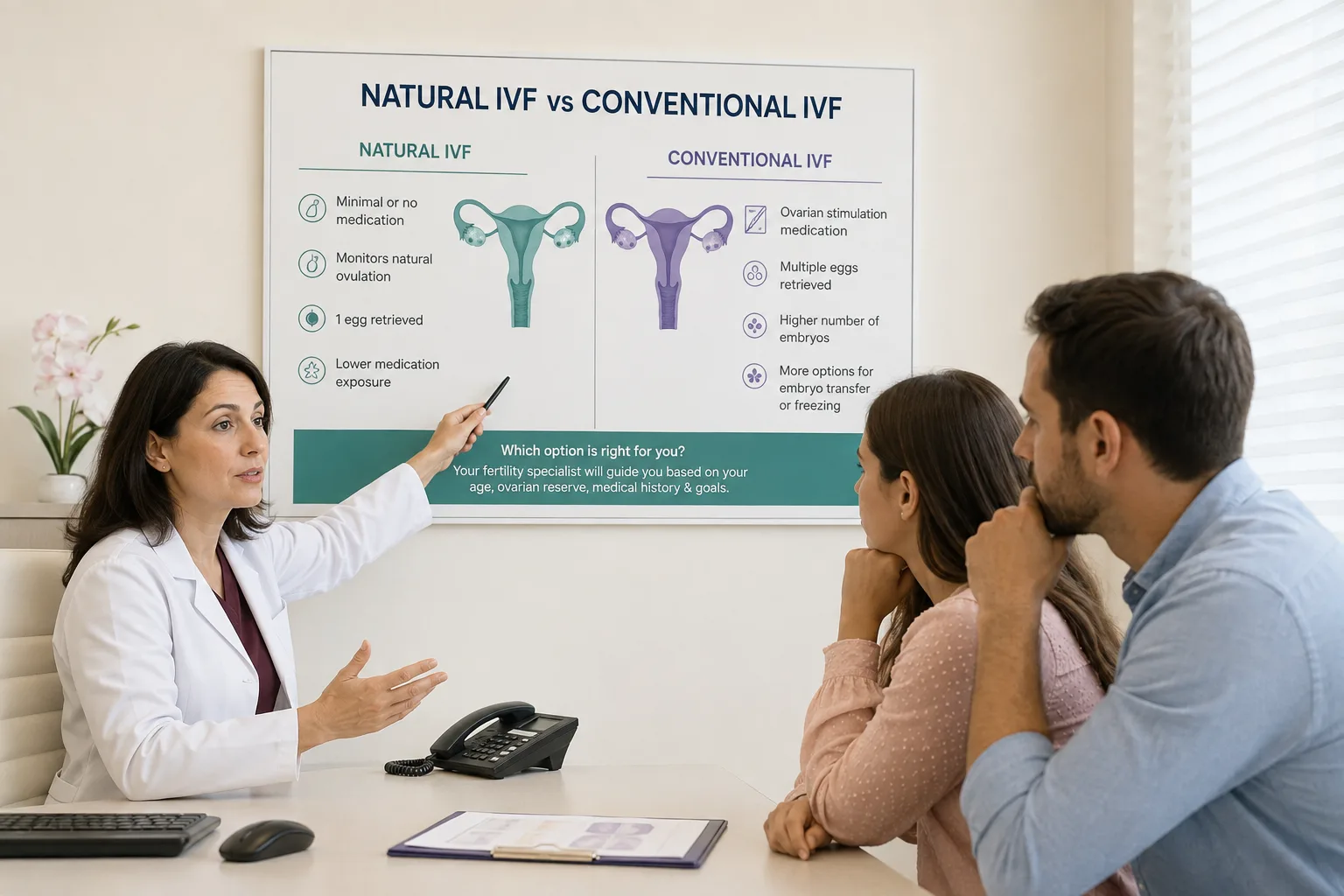
If you are considering fertility treatment, you may be wondering whether Natural IVF vs Conventional IVF is the better option for you. The main difference is how many eggs are stimulated and collected during treatment. Your age, ovarian reserve, fertility diagnosis, previous treatment, and personal preferences can all influence which approach is appropriate.
At Almond Blossoms Fertility and Wellbeing Center in Dubai Healthcare City, fertility specialists can assess your individual circumstances and explain which treatment pathway may make sense for you.
What Is the Difference Between Natural IVF and Conventional IVF?
Both Natural IVF and conventional IVF aim to help sperm and egg meet in a laboratory and create embryos that can potentially be transferred to the uterus. The biggest difference is the use of fertility medications and the number of eggs targeted during an IVF cycle.

What is Natural IVF?
Natural IVF, sometimes called natural-cycle IVF, works with the egg your body naturally develops during a menstrual cycle.
Instead of using medication to stimulate the ovaries to produce several eggs, treatment generally involves monitoring your natural cycle and retrieving the naturally developing egg when it is ready.
Because only one or sometimes very few eggs may be available, there may be fewer embryos created compared with conventional IVF.
Natural IVF may be considered in certain situations, particularly when ovarian stimulation is unsuitable, undesirable, or unlikely to produce many additional eggs.
What is Conventional IVF?
Conventional IVF (in vitro fertilisation) uses fertility medications to stimulate the ovaries to develop multiple follicles, which are the small structures in the ovaries where eggs develop.
The eggs are then collected during a procedure and fertilised in a laboratory. Depending on the situation, fertilisation may occur through conventional IVF or ICSI (intracytoplasmic sperm injection), where a single sperm is injected directly into an egg.
The aim is to create one or more embryos that can be assessed and, when appropriate, transferred to the uterus.
Natural IVF vs Conventional IVF at a glance
| Feature | Natural IVF | Conventional IVF |
| Ovarian stimulation | Little or no stimulation | Uses fertility medication |
| Eggs targeted | Usually one | Usually several |
| Medication | Generally less | More extensive |
| Embryo opportunities | Potentially fewer | Potentially more |
| Monitoring | Required | Required |
| Suitable for | Selected patients | Broad range of IVF patients |
| Main consideration | Limited number of eggs | Medication, monitoring and procedure burden |
Neither approach is automatically “better.” The right option depends on your fertility profile and treatment goals.
Natural IVF vs Conventional IVF: Which May Be Right for You?
There is no single IVF approach that works best for everyone. Your fertility specialist will usually consider several factors before recommending a treatment strategy.
Your age
Age can affect both egg quantity and egg quality. As egg numbers and quality can change with age, your specialist may consider whether attempting to obtain multiple eggs could provide additional opportunities for embryo development.
This does not mean conventional IVF is automatically better for everyone over a particular age. Your individual circumstances still matter.
Your ovarian reserve
Ovarian reserve refers to the remaining supply of eggs in your ovaries. Tests such as AMH (anti-Müllerian hormone) and an antral follicle count can provide information about ovarian reserve.
A lower AMH level does not, by itself, determine whether you can become pregnant or whether IVF will work. Instead, it is one part of the overall fertility assessment.
Your specialist may use your ovarian reserve results alongside your age, medical history and previous treatment response when discussing Natural IVF or conventional IVF.
Previous IVF experience
If you have previously undergone IVF, your response to ovarian stimulation can provide useful information.
For example, if previous stimulation produced only a small number of eggs, your fertility specialist may discuss whether repeating conventional stimulation is appropriate or whether another strategy should be considered.
Your personal preferences
Some people are particularly concerned about fertility medication, injections, monitoring or the physical demands of treatment.
Natural IVF can involve less medication, but that does not necessarily make it easier or more successful. It can also mean fewer eggs and therefore potentially fewer opportunities to create embryos in a given cycle.
The most appropriate choice is therefore a balance between your medical circumstances and what matters to you.
What Are the Benefits and Limitations of Natural IVF?
Natural IVF can be appealing because it involves less ovarian stimulation. However, it is important to understand both sides before choosing this approach.
Potential benefits of Natural IVF
Depending on your circumstances, potential advantages may include:
- Less or no ovarian stimulation medication
- Reduced exposure to fertility drugs
- Fewer medication-related side effects
- A treatment approach that follows your natural menstrual cycle
- Potentially less ovarian stimulation for people for whom this is a consideration
However, fewer medications do not automatically mean a higher chance of pregnancy.
Potential limitations of Natural IVF
The main limitation is the smaller number of eggs usually available.
With conventional IVF, several eggs may be collected in one cycle. With Natural IVF, there may be only one egg to retrieve.
This can mean:
- No egg is retrieved in some cycles
- The egg may not fertilise
- An embryo may not develop
- There may be no embryo available for transfer
For some patients, these limitations may make conventional IVF a more practical option.
What Are the Benefits and Limitations of Conventional IVF?
Conventional IVF has been used extensively in assisted reproductive medicine and can provide multiple eggs from a single stimulated cycle.
Potential benefits
A conventional IVF cycle may provide:
- Several eggs for fertilisation
- More opportunities to create embryos
- Potentially more than one embryo for consideration
- The possibility of embryo freezing when suitable embryos remain
- The opportunity for additional laboratory assessment when clinically appropriate
Having more eggs does not guarantee pregnancy. Egg quality, sperm factors, embryo development, uterine factors and age can all influence outcomes.
Potential limitations
Conventional IVF requires fertility medications and regular monitoring.
Some people may experience temporary effects such as bloating, breast tenderness, mood changes or discomfort during stimulation.
There is also a small risk of ovarian hyperstimulation syndrome (OHSS), a condition in which the ovaries respond excessively to stimulation. Modern fertility treatment uses monitoring and tailored protocols to reduce this risk.
Your fertility specialist can explain the expected medication schedule and potential risks before treatment begins.
Does Natural IVF Have a Higher Success Rate Than Conventional IVF?
Not necessarily. Natural IVF is not automatically more successful simply because it uses fewer medications.
Success rates can be influenced by several factors, including:
- Your age
- Egg quality
- Ovarian reserve
- Sperm quality
- Fertilisation
- Embryo development
- Uterine and endometrial factors
- Previous fertility treatment
- The specific treatment protocol
One important consideration is that conventional IVF may produce several eggs in one cycle, while Natural IVF may produce only one. This can affect the number of opportunities available for fertilisation and embryo development.
It is therefore better to discuss your individual expected outcomes with your fertility specialist rather than comparing Natural IVF and conventional IVF based on a single headline success rate.
Does more eggs always mean better IVF results?
No.
The goal of IVF is not simply to collect as many eggs as possible. The objective is to achieve a healthy embryo and, ultimately, a successful pregnancy and birth.
However, having several eggs can provide more opportunities for fertilisation and embryo development. Your specialist will therefore aim for an appropriate response rather than simply maximising egg numbers.
Can Natural IVF Be Used With ICSI or Genetic Testing?
The fertilisation and genetic-testing stages can be considered separately from the decision about ovarian stimulation.
For example, ICSI may be recommended when there are specific sperm-related concerns or particular treatment circumstances. During ICSI, an embryologist injects a single sperm directly into an egg to assist fertilisation.
Similarly, preimplantation genetic testing (PGT) may be considered in selected situations to assess embryos for particular genetic or chromosomal characteristics before transfer.
Whether ICSI or genetic testing is appropriate depends on your medical and reproductive history.
How Do Doctors Decide Which IVF Approach to Recommend?
Your fertility consultation should look beyond a single test result.
A specialist may consider:
- Your fertility history – including how long you have been trying to conceive and any previous pregnancies or treatments.
- Your age – because reproductive potential changes over time.
- Ovarian reserve – using appropriate blood tests and ultrasound assessment.
- Sperm factors – including sperm count, movement and morphology.
- Previous IVF response – if you have already undergone treatment.
- Your treatment goals – including whether embryo freezing or genetic testing may be relevant.
- Your preferences and wellbeing – including how you feel about medication, procedures and the emotional demands of treatment.
This personalised assessment is particularly important because fertility treatment can involve uncertainty and emotional pressure.
At Almond Blossoms, fertility care is combined with psychological wellbeing support, allowing emotional health to be considered alongside reproductive treatment rather than treated as an unrelated issue.
Natural IVF vs Conventional IVF: Which Should You Choose?
If you are deciding between Natural IVF and conventional IVF, avoid choosing based solely on the amount of medication involved.
Natural IVF may be worth discussing if you prefer a minimally stimulated approach or if your fertility specialist believes it could be appropriate for your circumstances.
Conventional IVF may offer advantages when obtaining multiple eggs could provide more opportunities for fertilisation and embryo development.
Your specialist may also recommend a different approach entirely based on your ovarian reserve, previous treatment response, age or other fertility factors.
The most appropriate IVF treatment is the one that fits your individual reproductive profile, not simply the one that sounds more natural or involves more eggs.
Conclusion: Choosing the Right IVF Approach for You
The decision between Natural IVF and conventional IVF should be based on your fertility assessment, treatment history, reproductive goals and personal preferences—not simply on the amount of medication involved.
Natural IVF can be a suitable option for some people, while conventional IVF may offer greater opportunities for egg retrieval and embryo development for others. A personalised consultation can help you understand the potential benefits, limitations and alternatives before making a decision.
At Almond Blossoms Fertility and Wellbeing Center in Dubai Healthcare City, fertility specialists can discuss your reproductive health alongside the emotional aspects of treatment, with psychological support available when needed.
Ready to understand which fertility treatment may suit you? Book a consultation with our fertility specialist at Almond Blossoms.
A Consultation in Dubai
→ Website
Frequently Asked Questions (FAQs)
Is Natural IVF better than conventional IVF?
Natural IVF is not universally better than conventional IVF. It may be appropriate for selected patients, while conventional IVF may provide more opportunities to retrieve and fertilise eggs. Your fertility specialist can assess which approach fits your circumstances.
Is Natural IVF cheaper than conventional IVF?
Natural IVF may involve fewer fertility medications, which can reduce some treatment costs. However, multiple Natural IVF cycles may sometimes be needed because fewer eggs are typically available per cycle. The total cost depends on your treatment plan.
How many eggs are collected with Natural IVF?
Natural IVF generally aims to retrieve the naturally developing egg from the menstrual cycle, so typically one egg is targeted. In some cycles, an egg may not be successfully retrieved.
Can I have ICSI with Natural IVF?
ICSI can potentially be used with an egg retrieved during a Natural IVF cycle when it is clinically appropriate. Your fertility specialist and embryology team can explain whether ICSI is suitable for you.
Which IVF treatment has the highest success rate?
There is no single IVF method with the highest success rate for every patient. Outcomes depend on factors such as age, egg and sperm quality, ovarian reserve, embryo development, and individual medical circumstances.