
- Resolve conflict without arguing by slowing down, listening actively, and discussing one issue at a time.
- Fertility stress can intensify disagreements, so couples benefit from emotional regulation and compassionate communication.
- A psychologist in Dubai can help couples develop healthier conflict-resolution skills and protect emotional wellbeing.
- Every relationship experiences moments when communication becomes difficult. During infertility, IVF treatment, pregnancy planning, or other major life challenges, those conversations often become even more emotionally charged. Partners may feel misunderstood, overwhelmed, frustrated, or emotionally disconnected even when both want the same outcome.
A Practical Guide for Couples
Conflict is a normal part of every close relationship. Even couples who deeply love and support each other can disagree about finances, family expectations, treatment decisions, communication, intimacy, or everyday responsibilities.
For couples going through fertility treatment, however, disagreements can feel particularly intense. IVF, IUI, fertility investigations, pregnancy planning, and uncertainty about outcomes can place significant emotional pressure on both partners. One person may want to discuss everything immediately, while the other may need time to process. Small misunderstandings can then become much larger arguments.
Learning how to resolve conflict without arguing does not mean avoiding difficult conversations or pretending that disagreements do not exist. Instead, it means learning how to communicate concerns without blame, listen without becoming defensive, and find solutions while protecting the relationship.
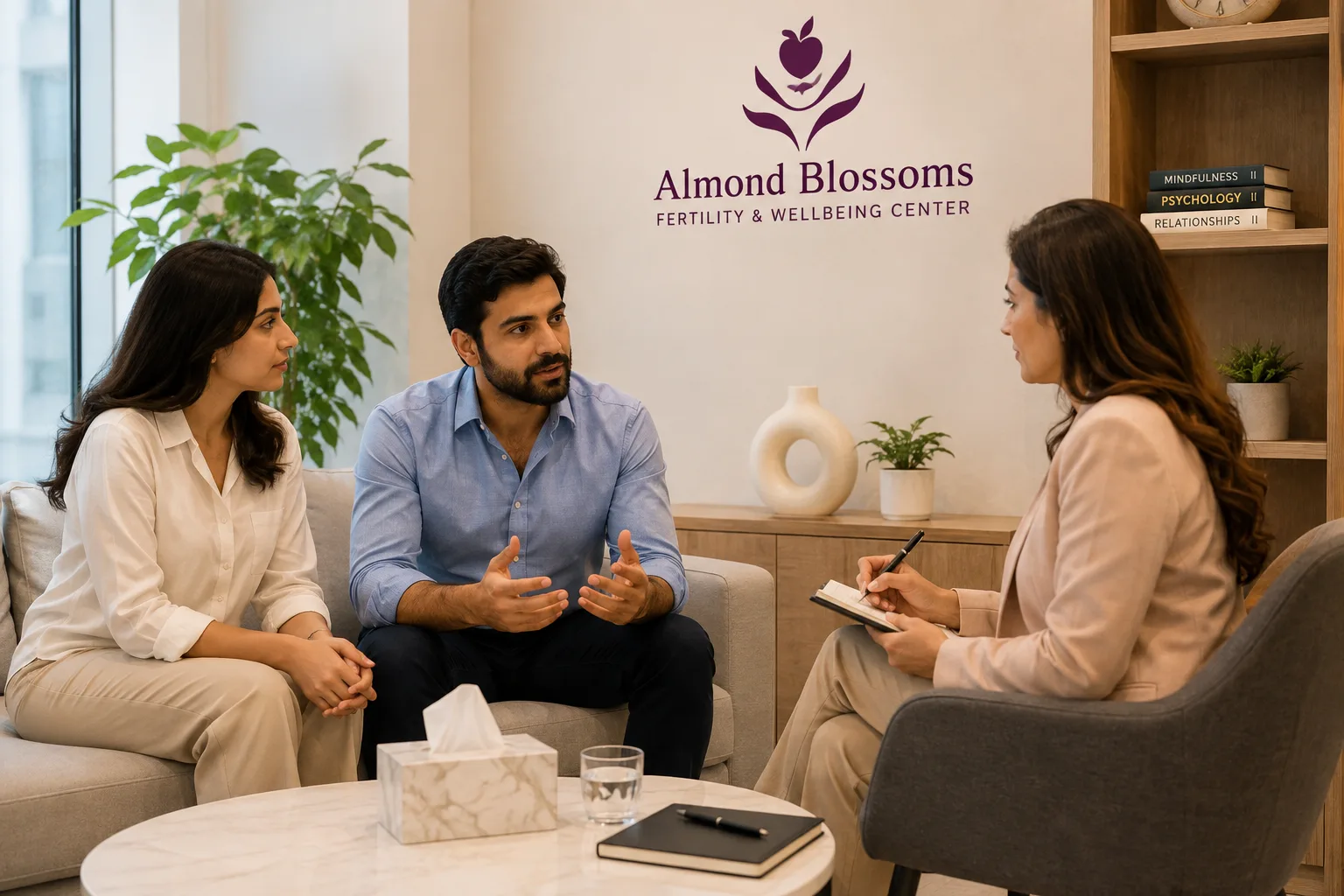
At Almond Blossoms Fertility and Wellbeing Center in Dubai Healthcare City, fertility and psychological wellbeing are considered together. This guide is medically and psychologically informed by specialists who understand the emotional challenges couples can experience during their reproductive journey.
What Does It Mean to Resolve Conflict Without Arguing?
Resolving conflict without arguing means addressing disagreement without turning the conversation into blame, criticism, shouting, withdrawal, or personal attacks.
Healthy conflict resolution involves several skills:
- Listening to understand rather than to win
- Expressing emotions clearly
- Identifying the actual problem
- Avoiding assumptions about your partner’s intentions
- Taking a break when emotions become overwhelming
- Finding mutually acceptable solutions
- Repairing the relationship after disagreement
The goal is not necessarily to make both partners think alike. The goal is to disagree safely and respectfully.
A healthy relationship can contain disagreement. What matters is how the couple manages it.
Why Do Couples Argue More During Fertility Treatment?
Fertility treatment can introduce several stressors into a relationship simultaneously.
Couples may be dealing with:
- Uncertainty about treatment outcomes
- Repeated appointments and investigations
- Hormonal medications and physical discomfort
- Financial concerns
- Work and scheduling pressures
- Family or cultural expectations
- Questions about pregnancy timing
- Different coping styles
- Fear of treatment failure
- Changes in intimacy and sexual expectations
One partner may respond to stress by wanting to talk, while the other may become quiet or emotionally withdrawn.
Neither response necessarily means that the person does not care.
Sometimes, two people experiencing the same stressful event cope with it in completely different ways.
Understanding this difference can prevent couples from interpreting normal stress responses as rejection, indifference, or lack of support.
How to Resolve Conflict Without Arguing
1. Pause Before Responding
When emotions become intense, the brain’s ability to process information calmly can decrease.
During a heated disagreement, you may become focused on defending yourself rather than understanding your partner.
Before responding, try a short pause.
You can say:
“I want to talk about this, but I don’t want us to hurt each other. Can we take a short break and come back to this?”
A pause should not be used as punishment or as a means of avoidance.
The important part is to return to the conversation once both people are calmer.
A healthy pause might include:
- Taking several slow breaths
- Walking briefly
- Drinking water
- Sitting somewhere quiet
- Writing down what you actually want to communicate
- Agreeing on when to continue the discussion
2. Focus on One Problem at a Time
Arguments often escalate because couples bring several old disagreements into one conversation.
For example:
“You never listen to me. And last month you did the same thing. You always do this.”
This makes it difficult to solve the current problem.
Instead, identify one specific issue.
For example:
“I felt unsupported when I had to attend the fertility appointment alone.”
This gives your partner something specific to understand and respond to.
Try this formula:
What happened → How I felt → What I need
For example:
“When we didn’t discuss the appointment beforehand, I felt alone. I need us to plan important fertility appointments together.”
This approach is usually more productive than assigning blame.
3. Use “I” Statements Instead of “You” Statements
One of the simplest psychological communication strategies is changing accusatory language into personal statements.
Instead of:
“You don’t care about what I’m going through.”
Try:
“I’m feeling emotionally alone, and I need more support right now.”
Instead of:
“You always make everything difficult.”
Try:
“I’m becoming overwhelmed, and I think we need to approach this differently.”
“I” statements do not guarantee your partner will agree with you, but they reduce the likelihood the conversation will immediately become defensive.
4. Listen Without Preparing Your Counterargument
Many couples believe they are listening when they are actually preparing their response.
Active listening requires temporarily putting your own argument aside.
Try these techniques:
Reflect
“What I’m hearing is that you felt I wasn’t supporting you.”
Validate
“I can understand why that would have hurt.”
Clarify
“Do you mean that you wanted me to come with you, or that you wanted me to ask how the appointment went?”
Validation does not mean agreeing with everything your partner says.
It means acknowledging that their emotional experience is real to them.
5. Identify the Emotion Beneath the Argument
The visible argument is not always the real problem.
For example:
Argument:
“Why didn’t you call me?”
Possible underlying emotion:
“I was worried that I wasn’t important to you.”
Another example:
Argument:
“You don’t want to continue treatment.”
Possible underlying emotion:
“I’m frightened that we’re losing our chance to become parents.”
In couples counselling, identifying these underlying emotions can be extremely important because anger is sometimes a secondary emotion covering fear, sadness, disappointment, loneliness, or insecurity.
Ask yourself:
“What am I actually feeling underneath my anger?”
That question can change the entire conversation.
6. Don’t Try to Win the Argument
Relationships are not debates where one person must be declared the winner.
If one partner “wins” by humiliating or silencing the other, the relationship can still lose.
Instead, ask:
“What outcome do we both want?”
For couples undergoing fertility treatment, the shared goal may be:
- Supporting each other emotionally
- Making informed treatment decisions
- Protecting intimacy
- Reducing unnecessary stress
- Feeling like a team
- Maintaining connection during uncertainty
Moving from “me versus you” to “us versus the problem” can fundamentally change the conversation.
7. Avoid the Four Communication Patterns That Escalate Conflict
Certain communication behaviours are particularly damaging when they become persistent.
Criticism
Attacking your partner’s character rather than discussing a specific behaviour.
Instead: Address the behaviour and its impact.
Contempt
Mocking, insulting, humiliating, or communicating superiority.
Instead: Express disagreement while maintaining respect.
Defensiveness
Immediately blaming your partner or making excuses.
Instead: Consider whether there is even a small part of their concern that you can acknowledge.
Stonewalling
Completely withdrawing from the interaction.
Instead: Ask for a structured break and agree to resume the conversation.
Recognizing these patterns early can help couples interrupt an escalating conflict before it becomes destructive.
8. Learn When to Take a Break
Sometimes continuing a conversation is less productive than stopping temporarily.
Consider taking a break if:
- Voices are becoming louder
- You feel unable to listen
- You are repeating the same points
- You are becoming verbally aggressive
- You feel overwhelmed
- You are tempted to say something intentionally hurtful
A useful statement is:
“I care about resolving this. I need some time to calm down, and I’d like us to continue talking later today.”
The distinction is important:
Healthy break: “Let’s pause and come back to this.”
Unhealthy withdrawal: “I’m done. Don’t talk to me.”
9. Discuss Fertility Decisions When You Are Both Calm
Major reproductive decisions should ideally not be made in the middle of an argument.
Couples may need to discuss:
- Whether to proceed with IVF
- IUI versus IVF
- Number of treatment cycles
- Embryo-related decisions
- Financial considerations
- Work arrangements
- Emotional boundaries with family
- How much information to share with others
Try scheduling a specific time for important conversations.
For example:
“Let’s discuss our treatment options tomorrow evening when neither of us is rushing.”
This creates emotional space for both partners.
10. Protect Your Relationship From Fertility Treatment Taking Over Everything
When fertility becomes the central focus of daily life, couples can gradually stop interacting as partners and begin interacting primarily as treatment coordinators.
Try maintaining activities that have nothing to do with fertility.
For example:
- Go for a walk together
- Have a meal without discussing treatment
- Watch a movie
- Spend time with friends
- Celebrate personal milestones
- Talk about plans unrelated to pregnancy
- Maintain affection without making intimacy solely about conception
Your relationship is more than your fertility journey.
When Should a Couple Consider Psychological Support?
Seeking professional support does not mean a relationship is failing.
A psychologist can help couples understand communication patterns, emotional triggers, coping styles, and unresolved concerns.
Consider professional support if:
- The same argument repeatedly occurs without resolution
- Communication has become hostile
- One or both partners feel emotionally disconnected
- Fertility treatment is creating significant relationship strain
- One partner feels unsupported or misunderstood
- Conversations routinely end in silence or anger
- Anxiety or sadness is affecting everyday functioning
- You cannot discuss treatment decisions calmly
A clinical psychologist can provide structured strategies rather than simply telling couples to “communicate better.”
How Can a Psychologist in Dubai Help With Relationship Conflict?
A psychologist in Dubai can work with individuals or couples to identify the patterns contributing to recurring conflict.
Depending on the situation, psychological support may focus on:
Communication Skills
Couples can learn how to express needs, listen actively, and discuss sensitive subjects without escalating conflict.
Emotional Regulation
Partners can learn techniques for recognizing and managing intense emotional responses.
Fertility-Related Stress
Psychological care can address anxiety, grief, uncertainty, treatment fatigue, and emotional pressure associated with infertility.
Relationship Support
Couples can work on trust, emotional intimacy, expectations, and communication.
Individual Psychological Support
Sometimes one partner needs individual support to process emotions before productive couples communication becomes possible.
The approach should be personalized according to the couple’s circumstances.
Why Choose an Integrated Fertility and Wellbeing Center?
Fertility treatment does not happen in an emotional vacuum.
Physical health, reproductive decisions, psychological wellbeing, relationship dynamics, and lifestyle pressures can interact with one another.
An integrated fertility and wellbeing center can therefore provide a more comprehensive environment in which patients can access reproductive and psychological support according to their needs.
At Almond Blossoms Fertility and Wellbeing Center, patients in Dubai can access fertility-focused care alongside psychological wellbeing services, creating an environment where emotional concerns can be recognized as part of the overall patient experience.
For someone searching for the best psychological clinic, it is important to look beyond a simple ranking and consider factors such as qualified professionals, appropriate clinical experience, patient-centred care, confidentiality, and whether the service is suitable for the individual’s specific needs.
Resolving Conflict in Dubai’s Fast-Paced Lifestyle
Dubai’s multicultural environment brings together couples from many different backgrounds. Partners may have different cultural expectations, family structures, communication styles, languages, and attitudes toward fertility treatment and mental health.
Expat couples may also be managing:
- Long working hours
- Career pressures
- Living away from extended family
- Financial responsibilities
- Different cultural expectations
- Limited social support
- Frequent travel
These factors can increase emotional pressure.
For couples living or working around Dubai Healthcare City, accessing appropriately qualified fertility and psychological professionals can make it easier to seek support without treating relationship difficulties as a personal failure.
A Simple 5-Step Conflict Resolution Method
When an argument begins, try this sequence:
1. Stop
Pause before reacting impulsively.
2. Regulate
Take time to calm your body and emotions.
3. Identify
Ask: What is the real issue underneath this disagreement?
4. Communicate
Use “I” statements and explain your needs clearly.
5. Repair
After the conversation, reconnect rather than simply moving on.
A simple repair statement can be:
“We didn’t agree, but I don’t want this disagreement to come between us.”
Sometimes a small moment of emotional repair can be more valuable than finding the perfect solution immediately.
Final Thoughts: You Don’t Have to Agree on Everything to Feel Connected
Conflict does not automatically mean that something is wrong with your relationship.
What matters is whether both partners can express difficult emotions, listen with empathy, maintain respect, and repair the relationship after disagreements.
For couples experiencing fertility challenges, this becomes especially important. The fertility journey can be physically demanding, emotionally exhausting, and unpredictable, but couples do not have to navigate its psychological challenges alone.
If repeated conflict, fertility stress, anxiety, or emotional disconnection is affecting your relationship, consider speaking with an appropriately qualified psychologist or fertility professional.
At Almond Blossoms Fertility and Wellbeing Center, Dubai Healthcare City, fertility specialists, gynecologists, and psychological wellbeing professionals can help patients receive compassionate, individualized care that recognizes both reproductive and emotional needs.
If you are struggling to communicate with your partner during your fertility journey, contact Almond Blossoms to discuss whether fertility counselling, psychological support, or a consultation with a fertility specialist may be appropriate for you.
A Consultation in Dubai
→ Website
Frequently Asked Questions (FAQs)
How can I resolve conflict without arguing with my partner?
Start by slowing the conversation down and focusing on one issue at a time.
Use calm “I” statements, listen actively, and take a short break if emotions become overwhelming.
“I felt alone when I attended the appointment without you, and I would like us to attend important appointments together when possible.”
Why do couples fight during IVF or fertility treatment?
Fertility treatment can create significant emotional, physical, financial, and practical pressure.
Uncertainty, treatment decisions, appointments, hormonal changes, and different coping styles can all contribute to relationship tension.
Partners may also experience infertility differently. One person may want to discuss every detail, while the other may cope by becoming quiet or focusing on practical tasks.
Can a psychologist help couples stop arguing?
Yes. A psychologist can help couples understand recurring conflict patterns and develop healthier communication and emotional-regulation skills.
The goal is usually not to prevent every disagreement but to make disagreements safer and more constructive.
When should I see a psychologist in Dubai for relationship problems?
Consider speaking with a psychologist when disagreements repeatedly escalate, communication breaks down, or fertility-related stress begins affecting your emotional wellbeing or relationship.
You do not need to wait until a relationship reaches a crisis before seeking professional support.
How can couples communicate better during fertility treatment?
Schedule important conversations when both partners are relatively calm, discuss one decision at a time, and make space for each person’s emotions.
Try to approach fertility treatment as a shared challenge rather than something one partner must manage alone.