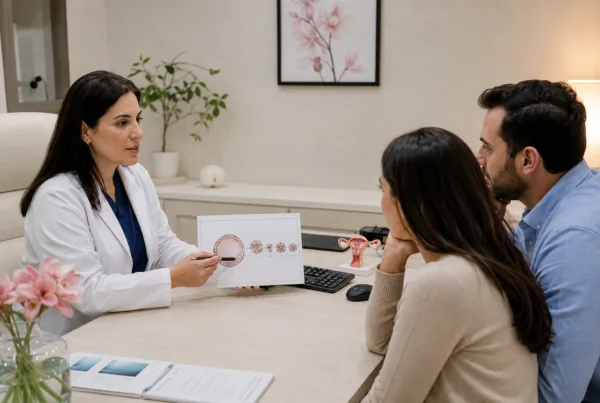
If you and your partner are going through a rough patch, arguing more, feeling distant, or struggling to communicate, you’re probably wondering whether couples therapy can actually help, and if so, which kind. It’s a fair question. Not all therapy approaches work the same way, and choosing the wrong fit can leave you feeling like you wasted time and money.
This is especially true for couples navigating fertility treatment, where stress on the relationship can be intense even when the partnership itself is strong. Below, we break down the most effective, evidence-based types of couples therapy, so you can walk into your first session with us or anyone else knowing what to expect.
What Makes Couples Therapy “Effective”?
Not every conversation with a counselor counts as effective therapy. Research-backed couples therapy relies on structured methods with a track record of measurable outcomes: better communication, fewer repeated conflicts, and stronger emotional connection.
At Almond Blossoms, our psychologists draw on several of these approaches rather than a one-size-fits-all script, adapting the method to what’s actually happening between you and your partner.

The Most Effective Types of Couples Therapy
1. Emotionally Focused Therapy (EFT)
EFT is one of the most researched approaches to couples therapy. It focuses on identifying the emotional patterns that drive conflict, often rooted in feeling unheard, unimportant, or disconnected from your partner.
Rather than just resolving the surface-level argument (whose turn it was to do something, for example), EFT helps you understand the deeper fear or need behind it. Couples often find this approach especially helpful when stress like fertility treatment has strained their sense of closeness.
2. The Gottman Method
Developed from decades of research observing real couples, the Gottman Method gives you practical tools: how to argue without contempt, how to repair after a fight, and how to build a stronger friendship as a couple.
It’s a good fit if you want concrete, structured exercises rather than open-ended emotional exploration.
3. Cognitive Behavioral Couples Therapy (CBCT)
CBCT looks at the thought patterns and assumptions that fuel conflict; for example, assuming your partner’s silence means they don’t care, when it may mean they’re overwhelmed. It’s particularly useful for couples stuck in repetitive arguments that seem to go nowhere.
4. Narrative Therapy
This approach helps couples separate the problem from the person; instead of “you’re the problem,” it becomes “this pattern is the problem, and we can change it together.” It’s often used alongside other methods rather than as a standalone approach.
Couples Therapy for Fertility-Related Stress
Fertility treatment, whether that’s IVF (in vitro fertilization, where an egg and sperm are combined outside the body before being placed in the uterus), ICSI (a variation of IVF where a single sperm is injected directly into an egg), or IUI (a simpler procedure where sperm is placed directly into the uterus), brings a unique kind of pressure to a relationship.
Appointments, injections, waiting periods, and uncertain outcomes can affect intimacy, communication, and how supported each partner feels. This is where an integrated approach matters: your psychologist understands the medical context you’re in, not just the relationship dynamics in isolation.
Common patterns we see in fertility-related couples therapy include:
- One partner feeling like they’re carrying the emotional weight alone
- Miscommunication about medical decisions or next steps
- Difficulty discussing setbacks like a failed cycle or difficult test result
- Intimacy becoming tied to “trying” rather than connection
How Do I Know If We Need Couples Therapy?
You don’t need to be in crisis to benefit from therapy. Signs worth paying attention to include:
- Arguments that repeat without resolution
- Feeling more like teammates managing logistics than partners
- Avoiding certain topics out of fear of conflict
- A noticeable drop in emotional or physical closeness
If any of this sounds familiar, particularly during a fertility journey, speaking with a psychologist for couples early on tends to be more effective than waiting until things feel unmanageable.
What to Expect From Your First Session
Your first session is mostly about listening and orientation, not diving into deep conflict resolution. A typical first appointment involves:
- Understanding what brought you in, in each partner’s own words
- A brief history of the relationship and any relevant medical context
- Setting initial goals together
- Agreeing on the therapy approach and session frequency going forward
There’s no pressure to have everything figured out before you arrive.
Finding the Right Support, Together
There isn’t a single “best” type of couples therapy; the right fit depends on what’s happening between you and your partner, and what kind of support feels right for your relationship. What matters most is working with someone who understands both the emotional and, where relevant, the medical context you’re navigating.
At Almond Blossoms Fertility & Wellbeing Center in Dubai Healthcare City, our psychologists work alongside our fertility specialists, so your therapy sessions can reflect the full picture not just the relationship, but everything you’re going through together.
If you’d like to talk through what type of support might help, book a consultation with one of our psychologists for couples.
A Consultation in Dubai
→ Website
Frequently Asked Questions (FAQs)
Is couples therapy only for relationships in crisis?
No. Many couples attend proactively to strengthen communication, prepare for a major life change like fertility treatment, or address recurring friction before it escalates.
How long does couples therapy usually take to show results?
This varies by couple and approach, but many people notice improved communication within a few sessions. Your specialist can give you a clearer timeline once they understand your specific situation.
Can we do couples therapy while going through IVF or ICSI?
Yes, in fact, it’s often most helpful during treatment, when stress and decision-making pressures are highest. Your psychologist can, where appropriate, coordinate with your fertility care team.
Do both partners need to attend every session
Most sessions work best with both partners present, though individual sessions are sometimes recommended alongside joint ones, depending on what’s being addressed
Is couples therapy confidential?
Yes. Sessions are private, and your psychologist will clearly explain the boundaries of confidentiality during your first appointment.