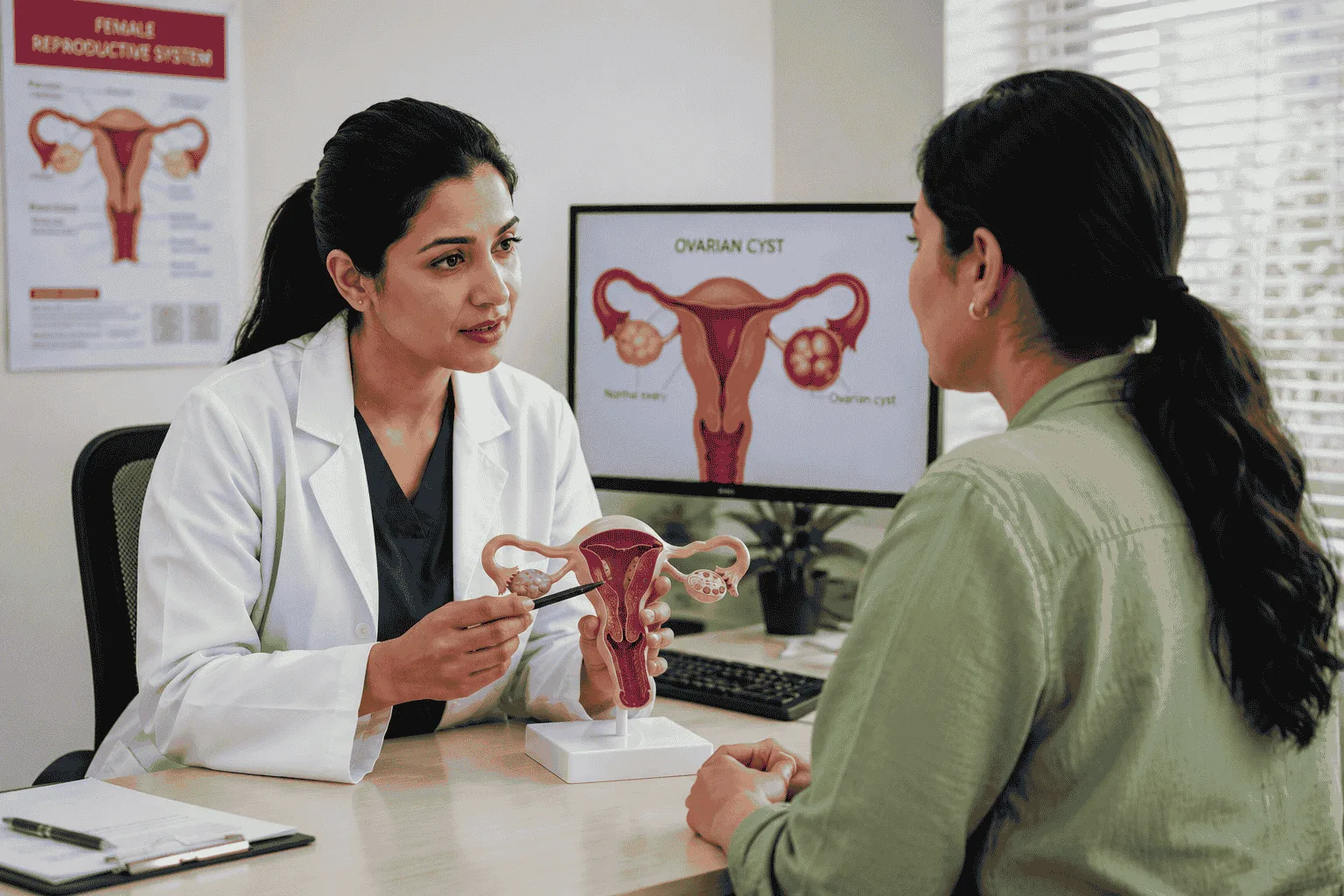
An ovarian cyst is a fluid-filled sac that develops in or on an ovary. Ovarian cysts are common, and many are harmless and disappear without treatment. However, some cysts can cause pelvic pain, menstrual changes, pressure, or fertility concerns and may require monitoring or treatment by a gynaecologist.
If you’ve recently been told that you have an ovarian cyst, it is understandable to have questions: Is it dangerous? Will it affect fertility? Does it need to be removed? Could it be cancer?
The good news is that most ovarian cysts are benign and do not require immediate treatment. What happens next depends on factors such as the cyst’s size, appearance, type, symptoms, age, and whether you have gone through menopause.
This guide explains what an ovarian cyst is, the different types, common symptoms and causes, how doctors diagnose cysts, when treatment may be necessary, and how ovarian cysts can relate to fertility.
Key Takeaways
- An ovarian cyst is a fluid-filled or partly solid sac that develops in or on an ovary.
- Many functional ovarian cysts develop as part of the menstrual cycle and disappear naturally within a few months.
- Persistent, large, complex, or symptomatic cysts may require closer monitoring, medication, a procedure, or surgery.
- Most ovarian cysts do not prevent pregnancy, but some underlying conditions or treatments can affect fertility.
- Sudden severe pelvic pain, particularly with nausea or vomiting, requires urgent medical assessment because torsion or rupture can occur.
What Is an Ovarian Cyst?
An ovarian cyst is a sac containing fluid, blood, or other material that forms in or on an ovary.
Ovaries normally change throughout the menstrual cycle. During ovulation, an egg develops inside a follicle. Normally, the follicle releases the egg and then changes as part of the normal cycle. Sometimes this process does not happen as expected, and the structure can enlarge and become a cyst.
Ovarian cysts are particularly common before menopause. Many are discovered incidentally during a pelvic examination or ultrasound because they do not cause noticeable symptoms.
Importantly, having an ovarian cyst does not automatically mean you have ovarian cancer. The vast majority of ovarian cysts are benign, although some cysts require additional investigation depending on their appearance and the person’s age and menopausal status.

What Are the Different Types of Ovarian Cysts?
Ovarian cysts can be broadly considered functional or pathological.
1. Functional ovarian cysts
Functional cysts are associated with the menstrual cycle and are the most common type.
They include:
Follicular cyst
A follicular cyst can develop when the follicle does not release an egg or continues growing after the expected point of ovulation.
Corpus luteum cyst
After ovulation, the follicle becomes the corpus luteum. Sometimes it fills with fluid or blood and forms a corpus luteum cyst.
These cysts are generally temporary and may disappear without treatment.
2. Pathological ovarian cysts
Pathological cysts are not necessarily related to the menstrual cycle. They can develop from abnormal cell growth.
Examples include:
- Dermoid cysts (teratomas)
- Cystadenomas
- Endometriomas
- Other complex ovarian masses
An endometrioma, sometimes called a “chocolate cyst,” can develop when endometriosis affects the ovary.
Some pathological ovarian cysts are benign, while a small proportion may be malignant. The appearance of the cyst on imaging helps doctors determine whether further investigation is needed.
What Causes Ovarian Cysts?
The cause depends on the type of cyst.
Common causes and associated conditions include:
Normal ovulation
The menstrual cycle is the most common reason functional ovarian cysts develop.
Endometriosis
Endometriosis can affect the ovaries and cause blood-filled cysts known as endometriomas.
Hormonal or reproductive conditions
Certain hormonal conditions can affect ovulation and ovarian function.
Fertility medication
Some fertility treatments that stimulate ovulation can increase the likelihood of enlarged ovaries or ovarian cyst formation. This is one reason fertility treatment is carefully monitored.
Abnormal cell growth
Less commonly, ovarian cysts can develop because of abnormal growth of ovarian cells.
What Are the Symptoms of an Ovarian Cyst?
Many ovarian cysts cause no symptoms at all.
When symptoms occur, they may include:
- Pelvic or lower abdominal pain
- A dull ache or pressure
- Bloating
- Feeling unusually full
- Pain during sexual intercourse
- Painful periods
- Irregular or heavier periods
- Difficulty emptying the bowel
- Frequent urination
- Abdominal swelling
- In some cases, difficulty becoming pregnant
The symptoms can vary considerably depending on the cyst’s size, location and type.
What does ovarian cyst pain feel like?
Ovarian cyst pain can feel like a dull ache, pressure, fullness, or sharper pelvic pain.
However, sudden and severe pelvic or abdominal pain is different and should not simply be assumed to be a normal ovarian cyst symptom.
Can an Ovarian Cyst Be Dangerous?
Most ovarian cysts are not dangerous.
However, complications can occasionally occur.
Ovarian cyst rupture
A cyst can rupture, potentially causing sudden pain and, depending on the circumstances, internal bleeding.
Ovarian torsion
A larger cyst can increase the risk of the ovary twisting around its supporting tissues. This is called ovarian torsion and can interfere with the ovary’s blood supply.
Seek urgent medical attention if you experience:
- Sudden, severe pelvic or abdominal pain
- Severe pain accompanied by nausea or vomiting
- Faintness or dizziness
- Rapidly worsening abdominal pain
- Severe pain with fever or feeling very unwell
These symptoms require prompt medical assessment rather than waiting for a routine appointment.
How Is an Ovarian Cyst Diagnosed?
If your doctor suspects an ovarian cyst, diagnosis may involve several steps.
1. Medical history and examination
Your gynaecologist may ask about:
- Your menstrual cycle
- Pelvic pain
- Previous ovarian cysts
- Pregnancy possibility
- Fertility history
- Medications
- Menopausal status
A pelvic examination may also be performed.
2. Ultrasound
Ultrasound is one of the most important tests for evaluating an ovarian cyst.
It can help determine:
- The cyst’s size
- Its location
- Whether it is fluid-filled
- Whether it has solid areas
- Whether it appears simple or complex
A repeat ultrasound may be recommended when monitoring is appropriate.
3. Additional tests
Depending on the person’s age, symptoms, and ultrasound findings, the doctor may recommend additional blood tests or imaging.
This is particularly important when there are features that require further evaluation.
Does Every Ovarian Cyst Need Treatment?
No.
Treatment is not automatically necessary simply because an ovarian cyst has been found.
Doctors generally consider:
- Cyst size
- Cyst appearance
- Type of cyst
- Symptoms
- Whether it is growing or persistent
- Age
- Menopausal status
- Fertility plans
- Whether there are concerning features
For many simple, functional cysts, watchful waiting is appropriate.
How Are Ovarian Cysts Treated?
Treatment depends on the individual situation.
1. Monitoring
If a cyst appears benign and is not causing significant symptoms, your doctor may recommend observation.
A follow-up ultrasound can determine whether the cyst is shrinking, remaining stable, or increasing in size.
Many functional cysts resolve naturally within a few months.
2. Medication
In selected situations, medication may be used to address symptoms or an underlying hormonal/reproductive issue.
However, medication does not make every type of ovarian cyst disappear.
Your treatment should therefore be based on the actual type and cause of the cyst rather than assuming all cysts require the same approach.
3. Ovarian cyst aspiration
In selected cases, ovarian cyst aspiration may be considered to drain cyst fluid.
This is different from surgically removing the entire cyst, and whether it is appropriate depends on the cyst’s characteristics and the patient’s clinical circumstances.
If you have been diagnosed with a cyst and are wondering whether drainage could be appropriate, discuss the available options with a gynaecologist.
4. Surgery
Surgery may be considered when a cyst is:
- Large
- Persistent
- Causing significant symptoms
- Increasing in size
- Complex or concerning on imaging
- Suspected to have malignant potential
Depending on the circumstances, procedures can include laparoscopic surgery or, for some large or concerning cysts, open surgery.
When fertility is important, the surgical plan should take ovarian reserve and reproductive goals into consideration whenever medically appropriate.
When Does an Ovarian Cyst Need to Be Removed?
There is no single cyst size that automatically means surgery is required.
The decision is based on the complete clinical picture rather than size alone.
A gynaecologist may recommend further intervention if the cyst is:
- Persistent or growing
- Causing significant or ongoing symptoms
- Large or difficult to monitor
- Complex or unusual in appearance
- Associated with complications
- Concerning for malignancy
- Affecting reproductive plans in a way that requires treatment
This is why an ultrasound report should be interpreted in context rather than based only on the number of centimetres.
Can an Ovarian Cyst Affect Fertility?
This is one of the most important questions for women trying to conceive.
Usually, no — but it depends on the type and underlying cause.
Most ovarian cysts do not prevent pregnancy. However, certain conditions associated with ovarian cysts can affect fertility. Endometriomas, for example, are associated with endometriosis, which can affect reproductive health.
Treatment can also have implications for fertility, particularly if ovarian tissue needs to be removed.
For women planning pregnancy, the goal is therefore not simply “remove the cyst.”
The better question is:
What is the safest way to manage the cyst while protecting reproductive health as much as possible?
This is where an individualized fertility assessment becomes important.
At Almond Blossoms Fertility & Wellbeing Center, fertility care can include options such as IVF and ICSI, IUI, ovulation induction, egg freezing, sperm freezing, embryo freezing, and genetic testing, depending on individual reproductive needs.
Ovarian Cysts and IVF: What Should You Know?
If you are preparing for IVF and an ovarian cyst is discovered, your fertility specialist may assess:
- The type of cyst
- Its size and appearance
- Whether it is producing hormones
- Whether it affects ovarian stimulation
- Your ovarian reserve
- Your fertility history
- Your planned treatment
Not every ovarian cyst means that IVF must be postponed.
Your fertility specialist can determine whether monitoring, treatment, or another approach is appropriate before beginning or continuing fertility treatment.
Can Ovarian Cysts Affect Egg Freezing?
If you’re considering egg freezing, an ovarian cyst may need to be assessed before ovarian stimulation.
The important factors include the cyst’s type, size, hormonal activity, and how it may affect the ovaries during treatment.
A fertility specialist can evaluate your individual situation before recommending a fertility preservation plan.
What If an Ovarian Cyst Is Found During Fertility Treatment?
Finding an ovarian cyst during fertility treatment does not necessarily mean that treatment has failed.
Your fertility team may reassess the cyst using ultrasound and determine whether it is:
- A functional cyst
- Related to recent ovulation
- Hormone-producing
- Persistent
- Complex
- Relevant to the treatment cycle
The next step depends on the clinical findings.
This individualized approach is particularly important because unnecessary procedures can sometimes be avoided, while cysts that genuinely require treatment should not be ignored.
Ovarian Cysts After Menopause
Ovarian cysts can occur after menopause, but they require a different level of attention because the risk of ovarian cancer is higher after menopause than before it.
Doctors may recommend ultrasound monitoring and, depending on the findings, blood tests or further investigation.
If you have gone through menopause and have been diagnosed with an ovarian cyst, discuss the finding with your gynaecologist rather than assuming it is the same as a typical functional cyst in a younger woman.
When Should You See a Gynaecologist for an Ovarian Cyst?
Consider arranging a gynaecological assessment if you have:
- Persistent pelvic pain
- Recurrent abdominal discomfort
- Pain during sex
- Unusual or irregular periods
- Persistent bloating or abdominal swelling
- A known ovarian cyst that is not resolving
- A cyst found incidentally on an ultrasound
- Difficulty conceiving
- Concerns about fertility after ovarian cyst treatment
A gynaecologist can determine whether you need monitoring, additional investigations or treatment.
Ovarian Cyst vs PCOS: Are They the Same?
No. An ovarian cyst and polycystic ovary syndrome (PCOS) are not the same condition.
An ovarian cyst is an individual sac or lesion that develops in or on an ovary.
PCOS is a hormonal and metabolic condition associated with ovulatory dysfunction and other clinical features. The small follicles seen in polycystic ovaries are not simply the same thing as a large ovarian cyst.
This distinction is important because the diagnosis, treatment, and fertility implications are different.
How Almond Blossoms Can Support Your Fertility Journey
An ovarian cyst can raise concerns that go beyond physical symptoms. If you are trying to conceive, considering fertility preservation, or already undergoing fertility treatment, you may also have questions about what the diagnosis means for your future fertility.
Almond Blossoms Fertility & Wellbeing Center in Dubai brings fertility treatment and psychological wellbeing support together.
Depending on your individual needs, fertility services may include:
- IVF & ICSI
- IUI
- Ovulation induction
- Egg freezing
- Sperm freezing
- Embryo freezing and storage
- Genetic testing
- Blastocyst transfer
- Fertility assessment and treatment
- Gynaecological care
Emotional wellbeing can also be an important part of fertility care, particularly when a diagnosis or treatment plan creates uncertainty or stress.
Conclusion
So, what is an ovarian cyst? It is a sac that develops in or on an ovary, often as part of normal ovarian activity. Most cysts are benign and disappear without treatment, but some require monitoring or medical intervention depending on their size, appearance, symptoms, and underlying cause.
If you have been diagnosed with an ovarian cyst, the most important step is not to panic or assume that surgery is necessary. Instead, have the cyst properly assessed by a qualified gynaecologist who can consider both your immediate health and, if relevant, your future fertility.
For women in Dubai who are concerned about an ovarian cyst, fertility, or treatment options, Almond Blossoms Fertility & Wellbeing Center provides an integrated approach to reproductive and emotional wellbeing.
Book a consultation with the Almond Blossoms team to discuss your ovarian cyst, fertility goals, and appropriate treatment options.
Medical note: This article is for general educational information and does not replace an individualized assessment by a qualified healthcare professional.
A Consultation in Dubai
→ Website
Frequently Asked Questions (FAQs)
What is an ovarian cyst?
An ovarian cyst is a fluid-filled or partly solid sac that develops in or on an ovary. Many ovarian cysts are benign, cause no symptoms, and resolve naturally without treatment.
What are the symptoms of an ovarian cyst?
Common symptoms can include pelvic pain, bloating, pressure or fullness, painful or irregular periods, pain during sex, bowel or urinary symptoms, and, in some cases, difficulty becoming pregnant. Many cysts cause no symptoms.
Can an ovarian cyst affect fertility?
Most ovarian cysts do not prevent pregnancy. However, some cysts, such as endometriomas, may be associated with conditions that affect fertility. Treatment decisions should also consider the woman’s reproductive plans.
When does an ovarian cyst need treatment?
Treatment depends on the cyst’s size, appearance, type, symptoms, persistence, age, and menopausal status. Many functional cysts can simply be monitored, while large, persistent, symptomatic or concerning cysts may require treatment.
When is an ovarian cyst an emergency?
Sudden severe pelvic or abdominal pain, particularly when accompanied by nausea, vomiting, dizziness or faintness, can indicate complications such as ovarian torsion or cyst rupture and requires urgent medical assessment.